
AI-narrated version of this post using a synthetic voice. Great for accessibility or listening while busy.
Reolink built its reputation on one thing that matters to self-hosters: cameras that record locally, without a monthly fee, and that generally speak standard protocols. Buy a PoE model, point it at a recorder you own, and the footage stays on your hardware. That is a different philosophy from cloud-first brands where the subscription is the product.
The trade-off is the software layer. Reolink’s app and NVR firmware set up quickly but are closed compared with an open NVR stack, and feature support varies model by model rather than across the whole catalogue. Two cameras in the same family can differ on RTSP behaviour, sub-stream resolution or whether a third-party recorder can pull both lenses.
This guide is for someone planning a wired camera setup they fully control, probably alongside Home Assistant or Frigate on a mini PC. It covers which Reolink models fit that goal, how the brand’s own NVR compares with rolling your own, and the network design that keeps the whole thing from leaking out to the internet.
The lineup at a glance
Reolink splits roughly into four groups: wired PoE cameras, plug-in Wi-Fi models, battery and solar Argus units, and the NVR plus Home Hub recording products. For a local, no-subscription build, the PoE cameras and the recorders do the heavy lifting.
Plug-in Wi-Fi is a reasonable compromise where cable cannot reach. Battery models are the one category that genuinely fights against 24/7 recording, for reasons covered further down.
| Model | Connection | Resolution / lens | Best role |
|---|---|---|---|
| RLC-811A | PoE, wired | 4K 8MP, 5X optical zoom, 123° diagonal FoV | Driveway, gate, long sight lines |
| Duo 3 PoE | PoE, wired | 16MP via two 4K sensors, 180° panoramic | Replacing two cameras on one corner |
| E1 Outdoor Pro | Dual-band Wi-Fi 6, plug-in power | 4K, 3X optical zoom, 355° pan / 50° tilt | Outdoor spots with no Ethernet run |
| E1 Pro | Dual-band Wi-Fi, plug-in power | 5MP 3K (2880×1616), pan-tilt, F1.6 | Indoor rooms, nursery, pet watching |
| RLN8-410 | 8-channel PoE NVR | 2TB pre-installed drive, 8 cameras | First-party recording, no Linux work |
RLC-811A: the reach camera
The RLC-811A is the one to buy when the subject is far away. Its varifocal lens gives 5X optical zoom without dropping below 8MP, which is the difference between knowing a car arrived and reading the plate. Wide mode covers 105° horizontal and 123° diagonal, so it doubles as a general-purpose bullet.
Being PoE, it needs one cable for power and data, and Reolink includes a 1m Cat5 lead for the pigtail connection only — you supply the run. Spotlights enable full-colour night video and a siren for deterrence, and recordings can go to a microSD card up to 512GB as a local fallback. Skip it where every position covers under about 10 metres; at short range the zoom is wasted.
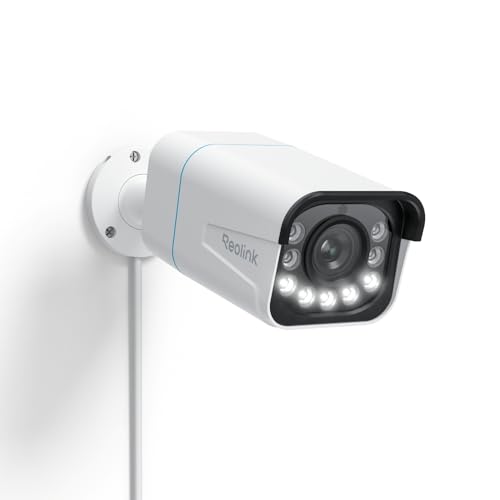
- 4K Ultra HD & 5X Optical Zoom & 123° Wide Angle: The varifocal lens allows you to 5X zoom in on the distant object wi…
- Human/Vehicle Detection with Smart Alerts: This 811A PoE camera uses advanced AI to accurately identify people and ve…
- Full Color Night Vision with Spotlights: This 4K outdoor camera enables you to view clear images with brilliant color…
Duo 3 PoE: one mount, two sensors
The Duo 3 PoE stitches two 4K sensors into a 180° panoramic image, covering a building corner or a wide back garden without mounting two cameras. The F1.6 aperture and 1/2.7″ CMOS pull in more light than a typical bullet, infrared LEDs are rated to about 100ft, and Motion Track composites a target’s path across one frame.
Two practical notes. The PoE injector, switch or NVR is not in the box, and neither is a DC adapter. And dual-lens stitched cameras are where third-party recorder support is most variable, so check how your software handles the stitched stream first.
Anyone who needs identifiable faces at distance should pick the zoom camera instead. A 180° view spreads pixels thin across the scene; that is the physics of panoramic coverage, not a flaw in this model.

- 16MP UHD & COLOR NIGHT VISION: Featuring two 4K image sensors, this dual-lens camera brings 16 UHD clarity to you, en…
- 180° PANORAMIC VIEW & MOTION TRACK: The dual-image stitching algorithms, coupled with 4-core SoC, create 180° panoram…
- SMART DETECTION & TWO-WAY TALK: Smartly detect person/car/animal movements from other objects, reducing false alarms….
PoE versus Wi-Fi, honestly
Wired PoE wins on reliability for one boring reason: continuous video is a continuous upload, and Wi-Fi is a shared medium. A camera streaming 4K around the clock competes with everything else on the band, and a dropped association means a gap in the recording. Where cable is impossible, plug-in Wi-Fi is the honest second choice — and plug-in matters, because mains power removes the sleep behaviour that breaks continuous recording. Our comparison of Reolink, UniFi and Amcrest PoE systems goes deeper on how the wired ecosystems differ.
Why battery and solar Argus models are the wrong tool here
Battery cameras sleep to survive. They wake on PIR, record a clip, then drop off the network, which means no persistent RTSP stream for Frigate or Blue Iris and no gap-free timeline. They are good at watching a shed with no power. They are not a 24/7 recording device.
RLN8-410 versus Frigate on a mini PC
The RLN8-410 is the low-effort route. Eight PoE channels, a 2TB drive pre-installed, room for an additional 8TB disk, and plug-and-play DHCP so the camera subnet runs independently of your main LAN and even without internet. It folds Reolink’s person, vehicle and animal detection into playback, with no subscription.
Its constraint is stated plainly in the specifications: Reolink PoE cameras only, in the 4MP to 16MP range. Mixing in a Dahua or Amcrest unit later is not an option.
Frigate on a mini PC goes the other way — any ONVIF/RTSP camera, your own detection models, native Home Assistant integration, and storage you size yourself. It costs setup time and some YAML. The Frigate hardware setup guide covers the whole build, and the mini PC and accelerator options explain where detection work actually happens.

- ONLY WORK WITH REOLINK IP CAMERAS: Work perfectly with all Reolink PoE 16MP/12MP/4K/5MP/4MP cameras, such as RLC-1212…
- PoE, EASY SETUP WITH PLUG & PLAY: PoE with only one Ethernet cable (up to 330ft) for Reolink PoE Cameras to transmit…
- FULL INTEGRATION WITH SMART REOLINK CAMS: The Reolink PoE NVRs can integrate human/vehicle/animal detection & playbac…
The Wi-Fi pan-tilt pair and the network around them
The E1 Outdoor Pro covers outdoor positions without Ethernet. It runs dual-band Wi-Fi 6 on 2.4GHz and 5GHz, shoots 4K, carries 3X optical zoom, and pans 355° with 50° of tilt plus auto-tracking of people and vehicles. Indoors, the E1 Pro handles nurseries and pet rooms at 5MP (2880×1616) with an F1.6 aperture, 360° pan-tilt coverage and crying detection. Its storage list is the useful detail for self-hosters: microSD up to 512GB, Reolink NVR, Home Hub, and FTP/NAS with RTSP/ONVIF support.

- 4K HD & 3X OPTICAL ZOOM: This 4k ptz camera provides high-quality color images in 4K HD at night, while the distance…
- WI-FI 6 & 2.4/5GHZ WIFI: E1 Outdoor Pro updates its WiFi network protocol to Wi-Fi 6, bringing a wider range, higher…
- 355° PAN, 50° TILT: This PTZ camera allows you to see a wider world as its lens can pan 355° and tilt 50°. With the s…

- 5MP QHD RESOLUTION: The professional 3K 5MP lens offers a resolution of 2880×1616 for crystal-clear images and videos…
- DUAL-BAND WI-FI: Stay connected with 2.4/5 GHz Wi-Fi, ensuring smooth frequency switching for a smooth live streaming…
- PT & AUTO TRACKING: Experience 360° coverage enabled by pan & tilt functionalities, no more hidden details or threats…
Sub-streams and a camera VLAN
Run object detection on the sub-stream, not the main stream. Frigate’s recommended pattern is a low-resolution sub-stream for continuous analysis, with the high-resolution main stream recorded only when something happens.
Put every camera on an isolated VLAN with no internet route, and allow only the recorder to reach it. Cameras are embedded Linux devices that rarely get long-term patches, so segmentation is the real security control. A managed switch with VLAN and PoE support handles both jobs on one box. For in-wall cabling or new circuits, follow local electrical code and use a licensed electrician where your area requires one.
Which one for your situation
Long driveway, gate or anywhere you need to identify people and vehicles at distance: the RLC-811A, with its zoom set once during install. Wide corner or a yard where two cameras would otherwise overlap: the Duo 3 PoE. Outdoor spot with mains power but no Ethernet: the E1 Outdoor Pro. Indoor room: the E1 Pro.
For recording, pick by appetite for maintenance. If you want it working this weekend and expect to stay with Reolink cameras, the RLN8-410 with its bundled 2TB drive is the direct path. If you plan to mix brands or want Home Assistant automations driven by detections, build Frigate on a mini PC and keep the cameras brand-agnostic.
A sensible hybrid exists too: run the RLN8-410 as the always-on recorder and PoE source, then pull RTSP sub-streams into Frigate for smarter detection. Our camera picks for Frigate by use case cover which models behave best in that arrangement.
How these picks were chosen: HomeNode compares products using manufacturer specifications, current Amazon listing details and published owner feedback. Products are not tested in-house, and listings change often, so confirm current specifications on the product page before buying.
Affiliate disclosure: As an Amazon Associate, HomeNode earns from qualifying purchases at no additional cost to you.