
Affiliate disclosure: As an Amazon Associate, HomeNode earns from qualifying purchases at no additional cost to you.
Short answer: For the coldest installations, the ANNKE C800 4-pack is the pick on paper, because the manufacturer states an operating range down to -22°F (about -30°C) inside an IP67 housing. If you need to read a plate at the end of a long rural driveway, the REOLINK RLC-811A and its 5X optical zoom gives you reach a fixed lens cannot, and the REOLINK Duo 2 PoE covers a wide yard in one 180° view instead of two cameras.
This guide is for homeowners in Canada and the northern US who already know they want wired PoE cameras and now have to decide which ones will still be recording in February. Prairie and northern Ontario installs are the hard case: multi-day stretches below -30°C, blowing snow, and a daily freeze-thaw cycle on any south-facing wall.
Most of what keeps a camera alive through that is installation, not the camera. If you are still deciding on a platform, start with our PoE camera system guide for Reolink, UniFi and Amcrest and come back to the cold-weather details here.
Temperature ratings, sealing and frost on the glass
Manufacturers publish an operating range, and the low end is the number to read. ANNKE states -22°F to 140°F for the C800, which covers almost every Canadian winter day but not the deepest Prairie cold snaps. A camera below its rated minimum does not necessarily die; it may simply stop booting, drop its stream, or come back when the sun hits it.
Two details decide how much margin you have. Cameras mounted under a soffit on a wall that leaks heat sit warmer than their surroundings, and a camera that stays powered generates a little heat of its own. Cutting power to save a few watts in winter removes that, which is why continuous 24/7 recording is kinder to hardware than scheduled operation.
IP66, IP67 and IK10 are three different promises
IP66 means protection against powerful water jets; IP67 adds temporary immersion. ANNKE rates the C800 at IP67 and Reolink rates the Duo 2 PoE at IP66, which is plenty for driven snow but says nothing about snow sitting against the housing for weeks. IK10 is an impact rating, not a weather one.
None of these ratings covers condensation. Fogging usually comes from humid air sealed inside during a warm-day installation, then chilled overnight. Mount cameras on a cold, dry day where you can, and do not open a housing outdoors in a snowstorm.
Dome, bullet or turret in snow country
Domes collect snow on the upper curve and bounce infrared light off the inside of the bubble when the acrylic frosts or scratches. Bullets shed snow well, but their sunshades hold a drift that eventually slides over the lens. Turrets like the C800 sit close to the mount with a short shade, which tends to stay clearer in blowing snow.
Heaters, PoE budget and switch placement
Heated housings exist for exactly this climate, and they change your power maths. A camera with an integrated heater draws its peak during cold start, when heater and camera come up together. Standard 802.3af gives a port 15.4W at the source; 802.3at raises that to 30W, and heated cameras are the main reason a home install needs the latter.
Check the switch’s total budget, not just its per-port rating. Eight ports at 30W is 240W, and many eight-port units are budgeted for far less. Our 8-port PoE switch guide covers how those budgets are published.
Put the switch indoors in a heated space. A basement or utility-room shelf with a UPS is the right home for the switch, the recorder and the drives.
Connectors and cable through freeze-thaw
Water that gets into an RJ45 in October expands when it freezes, and the joint is dead by January. Use outdoor-rated or direct-burial cable, make the connection inside a weatherproof junction box rather than taped in open air, and leave a drip loop so meltwater runs away from the housing.
Any run that leaves the building also deserves surge protection; our outdoor PoE surge protection guide explains grounding placement. Where work involves mains wiring, bonding to a building ground or anything inside a wall, follow your local electrical code and use a licensed electrician where it is required.
Snow glare, infrared and false alerts
Infrared illuminators light up falling snow the way headlights light up fog. Each flake near the lens becomes a bright blob, auto-exposure pulls the whole scene down, and motion detection sees a blizzard of movement. The fix is geometric: get the illuminator away from the lens axis.
Mounting under a deep soffit keeps snow out of the near field entirely, and angling the camera downward rather than level reduces the depth of snow it looks through. Where you need range, an external IR illuminator mounted a metre or two to the side removes the retroreflection almost completely. Spotlight-based colour night vision suffers the same backscatter.
Recorder settings that cut snowfall alerts
Alert on objects, not on motion. In Frigate that means filtering to person and car labels, raising the minimum score, and drawing zones that exclude the sky and the brightest snow-reflecting surfaces. On a standalone NVR, enable the camera’s own human and vehicle detection and leave pixel-based motion to the continuous timeline. All three cameras here classify on-device; our Frigate camera guide goes deeper on substream resolution.
Three PoE cameras compared
| Attribute | REOLINK RLC-811A | ANNKE C800 (4-pack) | REOLINK Duo 2 PoE |
|---|---|---|---|
| Resolution | 4K Ultra HD, 8MP | 4K UHD, 8MP | 4K UHD dual-lens |
| Lens and coverage | Varifocal, 5X optical zoom, 123° diagonal | Fixed 4.0mm, 96° diagonal | Two lenses stitched to 180° panorama |
| Stated weather rating | IP67 | IP67, -22°F to 140°F | IP66 |
| Housing style | Bullet | Turret | Dual-lens panoramic |
| On-device detection | Human, vehicle, animal | Human, vehicle | Person, vehicle, pet |
| Local storage | microSD up to 512GB | microSD up to 512GB | microSD up to 512GB |

- Unrivaled 4K in All Environments: This 4K PoE security camera has exceptional 4K UHD images realized, 120 dB true WDR…
- PoE – Easy Setup even for Beginners: Unlike analog IP cameras, this PoE (Power over Ethernet) security camera only ne…
- AI Humans & Vehicles Detection: With the advanced algorithms, the 4K IP security camera senses humans & vehicles and…
The C800 is the only one of the three with a published low-temperature figure, and it arrives as four turrets, which suits a full-house install done in one weekend. EXIR 2.0 with smart IR is quoted to 100 ft, and 120 dB true WDR helps on bright snow against dark siding.
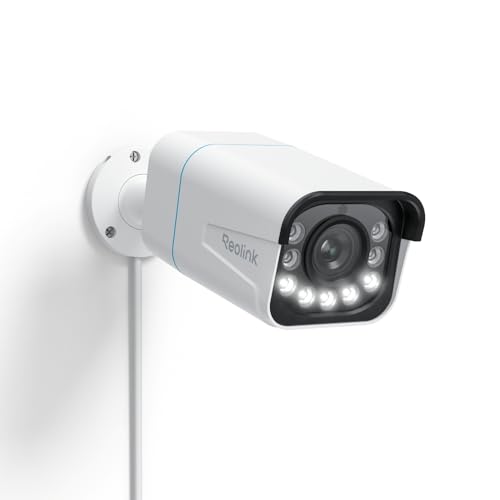
- 4K Ultra HD & 5X Optical Zoom & 123° Wide Angle: The varifocal lens allows you to 5X zoom in on the distant object wi…
- Human/Vehicle Detection with Smart Alerts: This 811A PoE camera uses advanced AI to accurately identify people and ve…
- Full Color Night Vision with Spotlights: This 4K outdoor camera enables you to view clear images with brilliant color…
The RLC-811A earns its place on reach. A 5X optical zoom at 8MP lets one camera watch a distant gate and still identify a vehicle, which matters on rural lots. It ships with a 1m Cat5 patch cable for the camera’s own pigtail, so plan your real run separately.

- 4K UHD VIDEOS WITH 180° VIEWING ANGLE: Combining two lenses into one view, this dual-lens security camera provides an…
- SMART PERSON/VEHICLE/PET DETECTION: Say goodbye to the unwanted alarms triggered by moving branches or flying bugs. T…
- INSTANT ALERTS & REMOTE ACCESS: The camera will send instant push/email alerts to your devices once it captures somet…
The Duo 2 PoE trades zoom for width: one mount, one cable, one 180° view across a yard or a double driveway, with spotlight colour night vision and a siren. Reolink advises routing cable away from heavy rainwater exposure or using a junction box, which is doubly true where ice forms. Our Reolink buyer’s guide covers how these fit the wider lineup.
Trade-offs and who should choose something else
If your site regularly sees -35°C or colder, none of these cameras is rated for it, and you should be shopping purpose-built heated housings or models with a published rating below -30°C. That usually means 802.3at PoE and a switch budget to match.
The Duo 2’s 180° view spreads 4K across a lot of scene, so pixels per metre at distance are lower than the RLC-811A’s zoomed view. If identification at range is the goal, width is the wrong trade. Conversely, a varifocal camera aimed down a driveway misses the side gate entirely. Anyone who needs vandal resistance with an IK10 impact rating should confirm it on the specific model rather than assume it.
The practical pick
Build around the C800 four-pack for general perimeter coverage, since it is the one with a stated cold rating and IP67 sealing. Add an RLC-811A on the single approach where you need identification at distance, and consider a Duo 2 PoE where a wide open area would otherwise need two cameras.
Then spend your remaining effort on the install: switch indoors on a UPS, junction boxes and drip loops at every camera, IR kept off the lens axis, and object-based alerting in the recorder.
Frequently asked questions
What operating temperature should a cold weather security camera have?
Look for a published low end below the coldest night your area sees. ANNKE states -22°F (about -30°C) for the C800, which covers most Canadian winters but leaves little margin during a deep Prairie cold snap.
Is IP67 better than IP66 for winter?
IP67 adds protection against temporary immersion on top of IP66’s resistance to powerful water jets, which helps where snow piles against a housing. Neither rating prevents internal condensation or lens fogging.
Why does falling snow trigger so many camera alerts?
Infrared and spotlight illumination reflects off flakes close to the lens, filling the frame with bright moving blobs. Mounting under a soffit, angling the camera downward, moving the illuminator off-axis and filtering alerts to person and vehicle objects all reduce it.
Do heated cameras need a different PoE switch?
Usually yes. Integrated heaters push peak draw past what 802.3af’s 15.4W per port supplies, so plan on 802.3at at 30W per port and check the switch’s total power budget rather than only its per-port figure.
How these picks were chosen: HomeNode compares products using manufacturer specifications, current Amazon listing details and published owner feedback. Products are not tested in-house, and listings change often, so confirm current specifications on the product page before buying.
Affiliate disclosure: As an Amazon Associate, HomeNode earns from qualifying purchases at no additional cost to you.