
AI-narrated version of this post using a synthetic voice. Great for accessibility or listening while busy.
If you have been watching local AI move from cloud APIs onto hardware you own, the Jetson Orin Nano Super developer kit sits in an awkward but interesting spot. It is not a desktop GPU, and it is not a Raspberry Pi with an accelerator bolted on. It is a small ARM board with an NVIDIA Ampere GPU welded to the same memory pool as the CPU, running the same CUDA-family software stack that powers server inference.
This guide is for people running a home lab who already have cameras, a NAS or a mini PC, and who want to understand what this board actually does well. The honest answer involves real limits: memory caps model size, storage is on you, and cooling matters once you run sustained inference rather than short demos.
This guide compares it on published specifications against the accelerator options most home labs reach for first, and against the used-GPU-in-a-mini-PC route that often wins on raw capability. There are cases where each is the right call.

- The NVIDIA Jetson Orin Nano Developer Kit sets a new standard for creating entry-level AI-powered robots, smart drone…
- The developer kit comprises a Jetson Orin Nano 8GB module and a reference carrier board that can accommodate all Orin…
- Jetson runs the NVIDIA AI software stack, with available use-case-specific application frameworks, including NVIDIA I…
What the Jetson Orin Nano Super Actually Is
The developer kit pairs a Jetson Orin Nano 8GB module with a reference carrier board that also accepts other Orin Nano and Orin NX modules. The module combines an Ampere GPU with a 6-core ARM CPU, and NVIDIA rates the Super kit at 67 INT8 TOPS, up from 40 TOPS for the original Orin Nano developer kit. That carrier board flexibility matters if you later want to move to a beefier module without rebuilding your whole project.
The “Super” part refers to a software update that raised clocks and memory bandwidth on Orin Nano hardware (NVIDIA lists bandwidth rising from 68 GB/s to 102 GB/s), and existing Orin Nano developer kits can get the same boost through a JetPack update. Practically, it means the board’s published performance figures are higher than the original Orin Nano launch numbers, and JetPack handles the power mode selection.
Unified Memory Is the Headline Constraint
The 8GB on the module is shared between the CPU and the GPU. There is no separate VRAM pool to fill. Anything the operating system, your camera pipeline and your model all need has to fit inside that same budget, which is the single most important thing to understand before you plan a project around it.
Vision AI: The Strongest Use Case
Object detection on camera streams is where this board earns its keep. NVIDIA’s DeepStream framework is built exactly for this — decoding multiple video streams in hardware, running detection on frames, and passing results downstream. YOLO-family detectors and NVIDIA’s own pretrained models run comfortably inside 8GB.
If you are building around IP cameras, the board can act as a dedicated inference node that classifies people, vehicles and packages without touching a cloud service. That pairs naturally with the kind of hardware described in our PoE camera system guide, where the cameras handle capture and something else handles thinking.
One caveat worth stating plainly: Frigate, the most popular self-hosted NVR among home labbers, has historically been easiest to deploy on x86 with a Coral TPU or Intel iGPU. Jetson support exists but has been less of a well-trodden path. If your goal is specifically a Frigate box, the mini PC plus Coral approach involves fewer surprises.

- A USB accessory that brings machine learning inferencing to existing systems. Works with Raspberry Pi and other Linux…
- Performs high-speed ML inferencing: the on-board edge TPU Coprocessor is capable of performing 4 trillion operations…
- Works with Debian Linux: connects to any debian-based Linux system with an included USB 3.0 Type-C cable
Camera Inputs and Sensors
The carrier board is designed with camera connectors and a broad set of I/O, which is why the kit is marketed for intelligent cameras, drones and robots. Ecosystem partners supply cameras, sensors and custom carrier boards, so sourcing optics for a build is not a dead end. For CSI-style experimentation, the same thinking in our Raspberry Pi camera modules roundup applies to sensor choice: global shutter for motion, NoIR for night work.
Small LLMs and Speech Models
You can run quantized language models on this board. Models in the 3B to 8B parameter range at 4-bit quantization fit in 8GB, with room getting tight at the upper end once the KV cache grows on longer prompts. llama.cpp, Ollama and TensorRT-LLM all have paths to Jetson.
Expect modest token rates. Memory bandwidth on an embedded module is a fraction of what a desktop card offers, and LLM generation is bandwidth-bound. A small assistant answering short questions feels fine. Long document summarisation does not.
Whisper-style speech recognition is a better fit. The small and base Whisper variants are compact, the workload is compute-bound rather than bandwidth-bound, and a board like this can transcribe voice commands for a home automation system without shipping audio anywhere. NVIDIA’s Riva framework targets conversational AI on Jetson specifically.
JetPack and CUDA vs Pi Accelerators
The software story is the real differentiator. Jetson runs NVIDIA’s AI stack, so CUDA, cuDNN and TensorRT are available, and a large share of published research code runs with minor changes. Hailo and Coral accelerators need models converted into their own formats, which works well for a fixed set of supported architectures and becomes frustrating outside it.
That flexibility costs you something. JetPack releases lag mainline Ubuntu, kernel versions are pinned, and Docker images have to be Jetson-specific ARM64 builds. Raspberry Pi OS is simpler to live with.

- HIGH PERFORMANCE: Features 26 TOPS (Trillion Operations Per Second) AI acceleration capability through the Hailo AI A…
- COMPATIBILITY: Specifically designed for the Raspberry Pi 5, connecting via PCIe interface for optimal data transfer…
- COMPACT DESIGN: Measures 65mm x 56.5mm, offering a space-efficient solution while maintaining full functionality as a…
| Option | Compute Type | Vendor-Stated AI Throughput | Model Format Flexibility | Best Fit |
|---|---|---|---|---|
| Jetson Orin Nano Super Dev Kit | Ampere GPU + 6-core ARM CPU | 67 TOPS (INT8) | Broad — CUDA, TensorRT, PyTorch | Vision pipelines, small LLMs, robotics prototypes |
| Raspberry Pi AI HAT+ (Hailo) | Dedicated NPU over PCIe | 26 TOPS | Narrow — Hailo-compiled models | Detection on a Pi 5 you already own |
| Google Coral USB Accelerator | Edge TPU over USB 3.0 | 4 TOPS | Narrow — TensorFlow Lite only | Frigate detection on any Linux host |
| Raspberry Pi 5 (8GB, CPU only) | Quad-core 2.4GHz CPU | No vendor AI rating | Broad but slow | General Linux services, light experiments |
| Used desktop GPU in a mini PC | Discrete GPU with dedicated VRAM | Varies by card | Broad — full CUDA or ROCm | Larger LLMs, training, higher token rates |
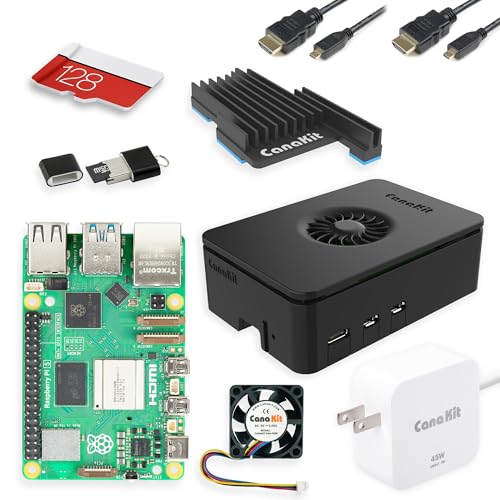
- Includes Raspberry Pi 5 with 2.4Ghz 64-bit quad-core CPU (8GB RAM)
- Includes 128GB Micro SD Card pre-loaded with 64-bit Raspberry Pi OS, USB MicroSD Card Reader
- CanaKit Turbine Black Case for the Raspberry Pi 5
Storage and Cooling You Need to Plan For
The kit expects you to add NVMe storage. Model weights are large, container images for Jetson are larger still, and running the OS from an SD card makes everything feel sluggish. The kit’s main M.2 slot takes a 2280 drive over PCIe Gen 3 x4, so a Gen 4 drive will not reach its rated speed there, but it works fine in that slot and its thermal efficiency is welcome in a compact enclosure.
The Samsung 990 EVO Plus fits that brief. Samsung rates sequential reads up to 7,150 MB/s and writes up to 6,300 MB/s, and highlights a nickel-coated controller aimed at lower power draw for similar performance. In a small board enclosure, the drive running cooler matters more than peak numbers you will never reach.

- GROUNDBREAKING READ/WRITE SPEEDS: The 990 EVO Plus features the latest NAND memory, boosting sequential read/write sp…
- LARGE STORAGE CAPACITY: Harness the full power of your drive with Intelligent TurboWrite2.0's enhanced large-file per…
- EXCEPTIONAL THERMAL CONTROL: Keep your cool as you work—or play—without worrying about overheating or battery life. T…
Thermals Under Sustained Load
Short benchmarks and continuous inference are different workloads. A board decoding several camera streams and running detection around the clock sits at high utilisation indefinitely, so airflow and mounting orientation deserve attention. If you plan to power anything from mains wiring or add circuits in a rack or cabinet, follow local electrical code and use a licensed electrician where that work requires one.
When a Used GPU in a Mini PC Wins
If your primary goal is running language models rather than watching cameras, the Jetson is the wrong tool. An older desktop GPU with 12GB or 16GB of VRAM will hold larger models and generate tokens far faster, because desktop memory bandwidth is in a different class entirely. Our guide to high-VRAM GPUs for local AI covers where the useful capacity thresholds sit.
Mini PCs can now host real graphics cards externally, and an OCuLink eGPU dock keeps the small-footprint appeal while adding serious inference capability. The trade-off is idle power and physical bulk — a Jetson draws a fraction of what a desktop card does at rest.
Choose the Jetson when low power, small size and an embedded form factor matter, or when you want to develop against the same NVIDIA stack that ships in commercial edge products.
The Practical Recommendation
Buy the Jetson Orin Nano Super developer kit if you want to build vision AI projects, prototype robotics, or run a compact always-on inference node. Add an NVMe drive immediately and treat the 8GB unified memory as a firm design constraint, not something to work around.
If you already own a Raspberry Pi 5 and just need object detection for a camera setup, the AI HAT+ or a Coral accelerator gets you there with less software friction and a smaller footprint. And if larger language models are the actual objective, put the money toward VRAM instead.
How these picks were chosen: HomeNode compares products using manufacturer specifications, current Amazon listing details and published owner feedback. Products are not tested in-house, and listings change often, so confirm current specifications on the product page before buying.
Affiliate disclosure: As an Amazon Associate, HomeNode earns from qualifying purchases at no additional cost to you.