
AI-narrated version of this post using a synthetic voice. Great for accessibility or listening while busy.
The Mac mini has quietly become one of the more interesting home server candidates available, and not because Apple designed it that way. Apple silicon pairs a large pool of fast unified memory with a chip that sips power when idle, which happens to be exactly the combination that makes local language models usable at home. If you already own a Mac mini, or you are weighing one against a small x86 box, the question is whether macOS can carry a 24/7 service load.
This guide is for people running the usual home server stack: Plex or Jellyfin, Home Assistant, a handful of Docker containers, maybe Immich or Paperless, plus some file storage. It assumes you want the machine on all the time, tucked away without a monitor, and that you would rather not babysit it.
The short version is that a Mac mini is a strong AI inference box and a decent media server, but a frustrating hypervisor host. Where that lands for you depends on how much of your stack expects Linux.
Why a Mac mini gets considered at all
Three things pull people toward Apple silicon for this job. Idle power draw on these chips is genuinely low for the performance on offer, the cooling is quiet under light load, and the 5-by-5-inch footprint fits on a shelf next to a router. None of that is unique to Apple, but the combination is hard to match.
The fourth reason is unified memory. The M4 Pro configuration here ships with 24GB of unified memory shared between CPU and GPU, which means a model loaded for inference can use most of that pool with GPU acceleration. On an x86 mini PC with integrated graphics, you are usually limited to a much smaller slice carved out for the iGPU, and discrete GPU memory is capped by whatever card you can physically attach.

- SIZE DOWN. POWER UP — The far mightier, way tinier Mac mini desktop computer is five by five inches of pure power. Bu…
- LOOKS SMALL. LIVES LARGE — At just five by five inches, Mac mini is designed to fit perfectly next to a monitor and i…
- CONVENIENT CONNECTIONS — Get connected with Thunderbolt, HDMI, and Gigabit Ethernet ports on the back and, for the fi…
Local LLMs: the one area Apple silicon clearly wins
Ollama and LM Studio both run natively on macOS and both use Metal for GPU acceleration without any driver hunting. Install, pull a model, done. That is a meaningfully shorter path than getting ROCm or CUDA working inside a container on a Linux host.
Memory capacity is what decides which models you can load, and quantised weights plus context have to fit. A 24GB pool comfortably handles mid-sized quantised models that will not fit in the fixed slice of system memory an x86 integrated GPU is usually given. Bandwidth matters for how fast tokens come out, and Apple’s wider memory bus is an advantage there too.
The alternative route on x86 is adding a real GPU over an external interface, which is covered in our look at OCuLink eGPU docks for mini PCs. That gets you more raw compute, at the cost of a second box, a power supply and considerably more noise.
Plex, Home Assistant and containers on macOS
Plex Media Server has a native macOS build and runs fine. Hardware-accelerated transcoding requires a Plex Pass on any platform, and the amount of acceleration available varies by chip and codec, so direct play remains the goal regardless of which machine you pick. Keep your clients capable and the server does less work.
Containers are where the friction starts. Docker on macOS does not run containers natively; it runs them inside a Linux virtual machine managed by Docker Desktop, OrbStack or Colima. That works, but you pay a memory tax for the VM, file sharing between macOS and the container filesystem is slower than a native bind mount, and host networking behaves differently than it does on Linux.
Home Assistant is the clearest casualty. Home Assistant OS expects to run as a VM or on bare metal, and the supervised add-on ecosystem is built around that. On a Mac you either run Home Assistant Container inside Docker’s Linux VM, which has no add-on store and means manual setup for anything add-ons would have handled, or run Home Assistant OS in its own virtual machine, which is one more layer to keep running.
Mac mini and x86 mini PC side by side
| Factor | Mac mini (Apple silicon) | x86 mini PC |
|---|---|---|
| Bare-metal hypervisor | No Proxmox or ESXi; macOS virtualisation frameworks only | Proxmox, TrueNAS, Unraid, plain Linux all supported |
| Container runtime | Linux containers run inside a VM layer | Native Linux containers on the host kernel |
| Memory for GPU inference | Unified pool shared by CPU and GPU | Small iGPU allocation, or an external GPU |
| Internal storage upgrades | Not user-serviceable; expand externally | Typically user-accessible M.2 slots |
| Guest OS flexibility | Linux ARM guests; limited x86 guest support | Any x86 guest OS, including Windows |
| Unattended reboots | FileVault and auto-login need planning | Standard headless boot behaviour |
Storage and expansion around a sealed box
The internal SSD in this configuration is 512GB and Apple offers no supported way to upgrade it later, so external storage is not optional for a media server. Thunderbolt and USB-C give you plenty of bandwidth; the decision is how many separate enclosures you are willing to live with.
For bulk media, a single large spinning disk is the simplest answer. The SanDisk Professional G-Drive uses a 7200RPM enterprise-class Ultrastar drive in a 12TB capacity with a USB-C connection rated to 10Gbps, and it is Time Machine compatible out of the box. It is one cable and one power brick for a lot of library space.

- USB-C (10Gbps) drive for fast backup with up to 250MB/s read and 250MB/s write (1 MB/s = 1 million bytes per second….
- High-capacity, enterprise-class Ultrastar 7200RPM drive inside
- Mac Ready, Apple Time Machine compatible; easily reformatted for Windows
For container data, databases and anything that gets written to constantly, use flash instead. The Samsung T7 Shield is a sensible choice at 2TB with USB 3.2 Gen 2 and an IP65 rating, and it draws its power from the bus rather than a wall adapter.
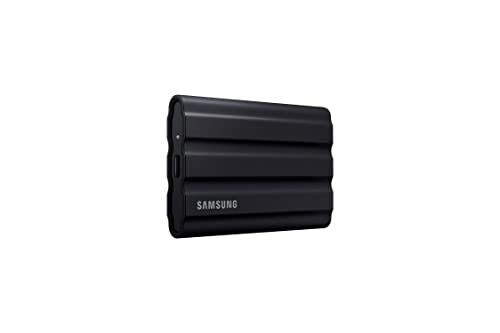
- GO THE DISTANCE: Withstand whatever adventure with the wildly reliable T7 Shield; It’s designed for the elements with…
- YOUR CONTENT CAPTURED: Take on the project, then transfer all your heavy files within seconds with the USB 3.2 Gen 2…
- SHARE IDEAS IN A FLASH: The T7 is embedded with PCIe NVME technology that brings you fast read and write speeds up to…
If the cable sprawl bothers you, a stand-style hub consolidates things. The Satechi Mac mini hub and stand adds an M.2 NVMe enclosure for up to 4TB, two 10Gbps USB-A ports, a USB-A 2.0 port and a UHS-II SD reader, with vents designed not to block the mini’s fan. The SSD is not included.

- Designed for Mac mini M6, M5 Pro, M4 Setups – Expand your Mac mini M6, M5 Pro, M4 with up to 4TB NVMe SSD storage and…
- 5-in-1 Front-Facing Expansion Ports – Features two USB-A 3.2 ports (up to 10Gbps), USB-A 2.0 (480Mbps), and UHS-II SD…
- Optimized Cooling & Aluminum Build – Heat-dissipating bottom vents and a recessed top ensure proper airflow without o…
Whatever you attach, external disks make a backup plan mandatory rather than optional. Our guide to home server backup software covers tools that work across both platforms.
Who should choose an x86 mini PC instead
If your plan involves Proxmox, a TrueNAS pool, VLAN-aware virtual switches or Home Assistant OS with add-ons, a Mac mini will fight you at every step. There is no bare-metal hypervisor option, and x86 guests are effectively off the table. That rules out a large slice of what people actually build home labs for, as our Proxmox home lab mini PC roundup lays out.
The KAMRUI E3B is a reasonable example of the budget alternative: a Ryzen 5 7530U with 6 cores and 12 threads, 16GB of LPDDR4X, a 512GB SSD and two M.2 2280 slots that each take up to 2TB (one accepts NVMe or SATA, the other SATA only). Memory is soldered, but the storage slots mean you can grow the boot and container volumes internally instead of hanging drives off USB. The 15W default TDP (AMD lists a 10-25W configurable range) keeps it in low-power territory.

- Powerful Mini Computer: KAMRUI E3B Mini PC with AMD Ryzen 5 7530U (6 cores, 12 threads), Zen 3 architecture, 15W TDP…
- Full-Function Type-C Port: This Mini Gaming PC includes a full-function Type-C port that supports charging, data tran…
- Expandable Storage: The KAMRUI E3B mini PC comes standard with 16GB of LPDDR4X memory (non-upgradeable). It also has…
The other consideration is maintenance rhythm. macOS updates and power cuts restart the machine, and if FileVault is enabled the disk can stay locked until someone enters a password, which is awkward for a headless box in a closet. Plan for either disabling FileVault on a server you physically control or accepting manual intervention after updates.
What we would actually recommend
Run local models on Apple silicon and everything else on Linux. If you are only buying one machine and local inference is the point, the Mac mini M4 Pro with 24GB of unified memory is the better buy, and you accept Docker-in-a-VM for your containers. Pair it with the G-Drive for media and the T7 Shield for container data.
If your stack is Plex plus Home Assistant plus a dozen containers and AI is a side interest, a small x86 box like the KAMRUI E3B is the less annoying machine by a wide margin. Add the Mac mini later when inference becomes the priority, and keep the two jobs separate. Our broader mini PC home server comparison is the place to start on that side.
How these picks were chosen: HomeNode compares products using manufacturer specifications, current Amazon listing details and published owner feedback. Products are not tested in-house, and listings change often, so confirm current specifications on the product page before buying.
Affiliate disclosure: As an Amazon Associate, HomeNode earns from qualifying purchases at no additional cost to you.