
AI-narrated version of this post using a synthetic voice. Great for accessibility or listening while busy.
Affiliate disclosure: As an Amazon Associate, HomeNode earns from qualifying purchases at no additional cost to you. Product availability subject to change.
Our smart plug energy monitoring guide covers a genuinely useful, low-cost way to track individual devices – plug in a lamp, a space heater, or an old fridge and see exactly what it’s costing you. The real limitation of that approach is coverage: a smart plug only sees what’s plugged into it, which leaves out anything hardwired – your HVAC system, an electric water heater, an EV charger, the central air conditioner – which is often where the largest and most controllable share of a home’s electricity bill actually lives. Whole-home circuit-level monitors solve that by installing at the breaker panel itself and watching every circuit simultaneously, and this category has matured into a genuinely useful, buyable product tier over the past couple of years.
Who This Category Is Actually For
If your electricity bill has crept up and you genuinely don’t know where the usage is coming from beyond guessing, or if a meaningful share of your home’s power draw comes from hardwired equipment a smart plug can’t reach, a panel-level monitor answers questions a plug-based approach structurally can’t. Skip this category if your main goal is simply tracking a handful of specific plugged-in devices – the smart plug guide linked above does that job for a fraction of the price and with a much simpler install. This tier makes the most sense for a household ready to install at the breaker panel (or comfortable paying an electrician a modest fee to do it) in exchange for a complete picture, not just a partial one.
What the Average US Household Is Actually Spending
The average US household spends $1,500 to $2,000 a year on electricity, and phantom load – power drawn by devices that are plugged in and idle rather than actively in use – is estimated by the NRDC to cost the average household around $165 of that annually, invisible unless you’re specifically measuring for it. A panel-level monitor is the tool that actually reveals where in that $1,500-2,000 the money is going, circuit by circuit, rather than requiring you to guess or measure one device at a time with a plug meter.
Comparison: The Current Whole-Home Monitor Landscape
| Device | Installation | Monitoring Granularity | App/Platform | Approx. Price |
|---|---|---|---|---|
| Sense Home Energy Monitor | Breaker panel (2 CT clamps, whole-home) | AI-driven device detection from aggregate load | Sense app, some smart home integrations | $300-350 |
| Emporia Vue Gen 3 | Breaker panel (up to 16 individual circuit CTs) | True per-circuit breakdown | Emporia app, Home Assistant integration available | $150-250 |
| Emporia Vue 2 | Breaker panel (up to 16 individual circuit CTs) | True per-circuit breakdown | Emporia app, Home Assistant integration available | $120-200 |
| Eyedro EyeFi-2 | Breaker panel (whole-home, 2 CT clamps) | Whole-home aggregate, no subscription required | Eyedro app/web dashboard | $130-160 |
| SPAN Smart Panel | Full panel replacement | True per-circuit breakdown + individual circuit control | SPAN app | $3,000-4,500+ installed |
The Picks
Sense Home Energy Monitor takes a different technical approach from the others here – rather than needing a sensor on every individual circuit, it uses two current transformer clamps on the main lines and an AI model to identify individual devices from the pattern of the aggregate load, which means simpler installation at the cost of device identification accuracy that improves over time rather than being exact from day one.
Emporia Vue Gen 3 takes the opposite, more direct approach – individual current transformer clamps on up to sixteen circuits gives a true per-circuit breakdown from the moment it’s installed, no learning period required, and it pairs with a genuinely useful Home Assistant integration for anyone building this into a broader home automation setup.
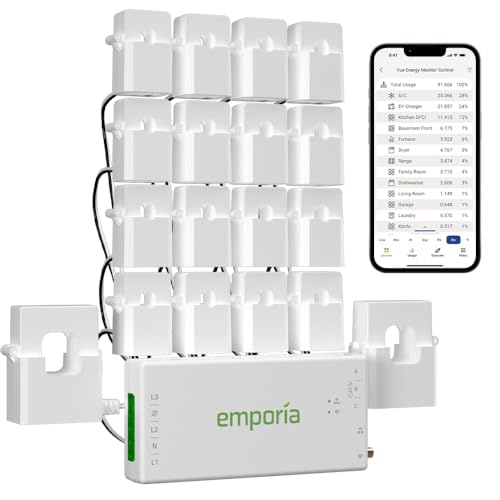
- SAFETY YOU CAN TRUST WITH UL CERTIFICATION: With Emporia Energy, your home energy monitoring is safe, reliable, and certified….
- INSTALLS IN CIRCUIT PANEL of most homes with clamp-on sensors. Supports Single phase, Single-split phase, and 2-wire systems. 3…
- 24/7 ENERGY MANAGEMENT AND MONITORING: Automate, manage and control your home’s real power anywhere, anytime to prevent costly…
Emporia Vue 2 is the previous generation of the same device, still fully capable and often available at a lower price – a sensible choice if the specific improvements in Gen 3 aren’t essential to your setup and the savings matter more.
Eyedro EyeFi-2 is the pick for anyone who wants whole-home monitoring without any ongoing subscription requirement at all – a straightforward two-clamp install with a web dashboard, at a price that undercuts Sense while covering the same basic whole-home monitoring use case.
SPAN Smart Panel is in a different category entirely from the others on this list – it’s not an add-on device but a full breaker panel replacement, which delivers true per-circuit monitoring and individual circuit control (including remote shutoff of specific circuits) at a genuinely high installed cost. This is the right tier only for a home already planning an electrical panel upgrade or replacement, EV charging, or solar/battery integration, where SPAN’s capabilities solve several problems simultaneously rather than being bought for energy monitoring alone.
Aggregate Detection vs. True Per-Circuit: The Real Technical Trade-off
This is the single most important distinction in this category, and it’s worth understanding before choosing between the Sense and Emporia approaches specifically. Sense’s aggregate-load AI approach requires no per-circuit wiring, making install simpler, but device identification improves gradually over weeks as its model learns your home’s specific electrical signature – it won’t perfectly separate every device from day one. Emporia’s per-circuit clamp approach requires more sensors and a more involved install (up to sixteen individual CT clamps inside the panel), but delivers an exact circuit-by-circuit breakdown immediately, with no learning curve. Neither approach is objectively better – it’s a genuine trade-off between install simplicity and immediate precision.
Panel Installation Safety: This Is Not a DIY Plug-and-Play Product
Every device in this comparison except SPAN’s full panel replacement still requires opening your home’s electrical panel to install current transformer clamps on individual breakers or main lines, and SPAN’s option requires a full panel swap. This is meaningfully more involved than a smart plug and genuinely carries electrical safety risk if done incorrectly. If you’re not specifically comfortable and experienced working inside a live breaker panel, hire a licensed electrician for the install – the cost is modest relative to the device price and the safety margin is worth it, especially for a first-time install.
What You Actually Do With the Data Matters More Than the Data Itself
A panel-level monitor is genuinely useful only if the insight translates into action – identifying that a specific circuit or appliance is drawing far more than expected, catching an HVAC system running inefficiently, or spotting phantom load from equipment that should be fully off but isn’t. Budget time in the weeks after installation to actually review the breakdown by circuit rather than installing the device and letting it run unexamined in the background; the entire value of this category over a basic utility bill is turning a single monthly number into an actionable, per-circuit picture you can do something about.
Panel Space and CT Clamp Count Can Limit Which Device Fits Your Home
Before buying a per-circuit device like the Emporia Vue, count your breaker panel’s actual circuits and confirm the clamp count you’re buying covers what you actually want monitored – a busy panel with more than sixteen active circuits will need either prioritizing which circuits matter most or stepping up to a higher-clamp-count bundle, since not every circuit will fit within a standard kit. It’s also worth confirming your panel has physical room to route and secure the additional clamps and wiring without overcrowding an already tightly packed panel, particularly in an older home where the panel itself may already be close to its practical capacity. This is a detail worth checking, or having an electrician confirm, before ordering rather than discovering a fit problem mid-install.
Solar and EV Charging Are Where This Category Earns Its Keep Fastest
Whole-home monitoring is genuinely useful for a standard household just trying to understand its bill, but it becomes considerably more valuable the moment solar panels or an EV charger enter the picture, since both introduce a second direction of power flow and a large, specific load that’s worth tracking on its own circuit. A household with solar wants to see production versus consumption in real time to understand actual grid dependence, not just a single net number on a utility bill weeks later; a household charging an EV wants to see exactly how much of the bill increase traces to charging versus everything else, especially useful for timing charging to off-peak utility rates where those exist. Both Emporia’s per-circuit clamps and SPAN’s full panel replacement handle this well; Sense’s aggregate approach can track solar production with an additional sensor kit but is less precise for isolating a single large load like EV charging from the rest of the home’s usage.
Utility Rate Structures Change What the Data Is Actually Worth
The financial value of circuit-level monitoring depends partly on your utility’s rate structure, which is easy to overlook when comparing devices purely on hardware specs. A flat per-kWh rate makes the math simple – see high usage, estimate the cost, decide whether to act on it. A time-of-use rate structure, where electricity costs meaningfully more during peak hours, makes the same monitoring data considerably more actionable, since shifting a specific circuit’s usage (an EV charger, a pool pump, a water heater) to off-peak hours can produce real savings that a flat-rate household simply can’t access in the same way. Check your utility’s actual rate structure before assuming a given monitor’s real-time data will translate into savings – the device does the same job either way, but the potential payoff differs by rate plan.
The Practical Recommendation
For most households wanting real circuit-level detail without a full panel replacement, the Emporia Vue Gen 3 is the strongest buy – true per-circuit accuracy from day one, a reasonable price, and genuine Home Assistant integration for anyone building this into a broader home automation setup. If simpler installation matters more than immediate per-device precision, the Sense monitor is a legitimate alternative, understanding that its device identification improves over the first several weeks rather than being exact immediately. Choose the Eyedro EyeFi-2 specifically if avoiding any ongoing subscription is a priority. Reserve the SPAN Smart Panel for a home already planning a broader electrical upgrade – EV charging, solar, battery backup – where its higher cost is justified by solving several problems at once, not for energy monitoring as a standalone goal.
Related Auburn AI Products
Building a homelab or self-hosting content site? Auburn AI has practical kits: