
AI-narrated version of this post using a synthetic voice. Great for accessibility or listening while busy.
A UPS is the dullest box in a home lab and the one that saves you the most grief. Unclean power is how NAS volumes end up needing a parity rebuild, how a Proxmox host comes back with a corrupt VM disk, and how a cable modem decides it wants a factory reset at 3am. APC has been the default answer to that problem for decades, which is exactly why the catalogue is so confusing.
This guide is for anyone working out whether a small Back-UPS behind the router is enough, or whether a NAS and a home server justify stepping up to a Back-UPS Pro or a Smart-UPS. We compared the current consumer and small-server lines on the specifications APC publishes, and on the two factors that actually decide fit: real watts and output waveform. APC changes model suffixes and bundled features regularly, so the product page is always the final word.
What APC Is Known For, and the Catch
APC’s strengths are distribution and longevity. Replacement battery cartridges are easy to find years later, the units are UL certified, and the firmware behaviour is predictable enough that Synology, TrueNAS and Network UPS Tools all have mature support for them.
The catch is model naming. BE, BX, BR and BR…MS all sit under the “Back-UPS” umbrella but differ in topology, waveform and outlet layout, and two units with the same VA rating can behave very differently when an active-PFC power supply is attached. Decoding the suffix is most of the buying decision.
The APC Lineup at a Glance
Back-UPS BE units are standby designs: they pass mains through and flip to battery when voltage leaves tolerance. Back-UPS Pro BX adds automatic voltage regulation, so brownouts get corrected without touching the battery. Back-UPS Pro BR…MS adds pure sine wave output. Smart-UPS (SMC/SMT) is the small-server line, with pure sine wave, a SmartSlot for network management cards and switchable outlet groups.
| Model | Line | Capacity | Waveform | Stated runtime at 100W | Battery cartridge |
|---|---|---|---|---|---|
| BE600M1 | Back-UPS (standby) | 600VA / 330W | Simulated sine | 23 minutes | APCRBC154 |
| BE850G2 | Back-UPS (standby) | 850VA / 450W | Simulated sine | 35 minutes | RBC17 |
| BX1500M | Back-UPS Pro, AVR | 1500VA / 900W | Simulated sine, active PFC compatible | 68 minutes | APCRBC124 |
| BR1500MS2 | Back-UPS Pro, AVR | 1500VA / 900W | Pure sine | 73 minutes | APCRBC163 |
| SMC1500C | Smart-UPS, AVR | 1500VA / 900W | Pure sine | Not listed in product data | Not listed in product data |
Sizing and Waveform: The Two Numbers That Matter
Size by watts, not VA
VA is apparent power; watts is real power. The marketing number on the box is VA, but your gear draws watts, and on these units the watt rating is roughly 55 to 60 percent of the VA figure. A 1500VA Back-UPS Pro supports 900W.
Add up the nameplate draw of everything you want backed up, then aim to sit around half the unit’s rating. Running near the limit shortens runtime sharply and leaves nothing spare when drives spin up together. Our write-up on choosing a UPS for a home server or NAS walks through the load-adding step in more detail.
Runtime is non-linear
Published figures like 23 or 68 minutes are quoted at 100W. Double the load and runtime drops by much more than half, because lead-acid batteries deliver less total energy at higher discharge rates. If your goal is a graceful shutdown rather than riding out a long outage, five to ten minutes of real headroom is usually plenty. Keeping a satellite link alive is a different calculation, which we cover in the guide to keeping Starlink online during an outage.
Stepped sine versus pure sine
Most modern desktop and server power supplies use active power factor correction. Some of those supplies dislike the abrupt transitions of a stepped approximation and respond by shutting down or buzzing on transfer. The BX1500M is listed as active PFC compatible, but a pure sine unit removes the question entirely — that is the argument for the BR1500MS2 and the Smart-UPS.
The Models Worth Considering
APC BE600M1 — the modem and router unit
330W, five battery-backed outlets, two surge-only, a 1.5A USB charging port and 490 joules of surge protection. This suits a modem, router and maybe a Pi or a small switch. Skip it if a NAS with spinning drives is in the plan.
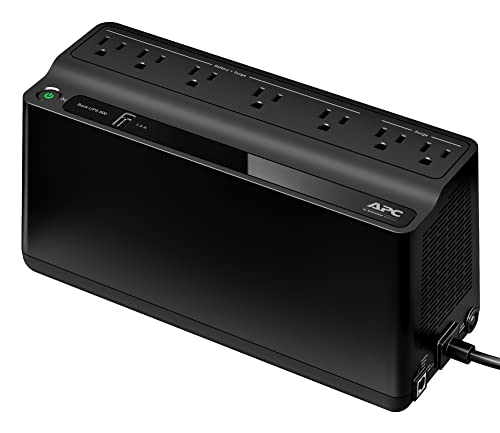
- KEEP YOUR COMPUTER, WI-FI AND ROUTER RUNNING THROUGH POWER OUTAGES: Supplies short-term battery power during outages…
- POWER PROBLEMS DON'T ONLY HAPPEN DURING STORMS: 23 minutes of runtime (at 100W load) guards against outages, while su…
- PROTECT EVERYTHING ON YOUR DESK: 5 well-spaced outlets with full battery backup and surge protection, plus 2 surge-on…
APC BE850G2 — small desk plus a two-bay NAS
450W across six battery-backed and three surge-only outlets, plus two shared USB-A ports and a silenceable alarm. A reasonable fit for a compact NAS and network gear together. Still a standby topology with no AVR, so it is less suited to homes with chronic sagging voltage.

- KEEP WORKING WHEN THE POWER GOES OUT: 850VA/450W provide up to 35 minutes of runtime at 100W to save work, shut down…
- PROTECTS YOUR WHOLE HOME OFFICE SETUP: Battery backup keeps your computer, router, modem, NAS, and smart home gear ru…
- 9 OUTLETS + 2 USB-A CHARGING PORTS: 6 battery-backup and 3 surge-only NEMA outlets, plus 2 USB-A ports (5V/2.4A share…
APC BX1500M — the value capacity pick
900W, AVR that corrects from 88V upward, an LCD showing load and estimated runtime, ten outlets, and coax plus Ethernet surge protection. It covers a server and NAS together. Check your PSU’s behaviour on simulated sine wave before committing.

- 1500VA / 900W RELIABLE BACKUP POWER: The highest VA capacity available for home use; delivers short-term battery powe…
- TEN PROTECTED OUTLETS: Power your entire setup with 5 battery backup outlets for essential devices, and 5 surge-only…
- AUTOMATIC VOLTAGE REGULATION (AVR): Corrects low voltage brownouts (88V+) and surges (+/-13%) without draining batter…
APC BR1500MS2 — the best all-round home lab choice
Same 900W and AVR as the BX, but with pure sine wave output, USB-C and USB-A charging, data-line surge protection and a three-year warranty. For a NAS and a mini PC or tower server, this is the unit we would point most readers to.

- 1500VA/900W – POWERS YOUR FULL SETUP: Handles demanding systems with real headroom. Up to 73 minutes of runtime at 10…
- PURE SINE WAVE UPS – SAFE FOR SENSITIVE ELECTRONICS: Unlike basic UPS units that output simulated sine wave, this del…
- AVR PROTECTS AGAINST BROWNOUTS & SPIKES: Automatically corrects voltage that's too high or too low without switching…
APC Smart-UPS SMC1500C — for a small rack or wiring closet
900W pure sine in a tower chassis with eight NEMA 5-15R outlets, a SmartSlot, AVR, LCD and SmartConnect cloud monitoring. The switchable outlet group lets you drop non-critical gear first. Overkill behind a single NAS.

- Power Capacity: 1500VA / 900W Pure Sine Wave UPS battery backup provides reliable power protection for your equipment
- Connection Options: Input NEMA 5-15P plug with output featuring (8) NEMA 5-15R outlets for multiple device connectivity
- Automatic Voltage Regulation (AVR): Adjusts high and low voltages to a safe level, helping preserve the life of the b…
Software, Signalling and the Ecosystem
APC’s own PowerChute software is Windows and macOS oriented, and the useful path for most home labs is the UPS’s USB port feeding a NAS or server directly. Synology DSM, TrueNAS and NUT all handle APC USB units and can then act as a network UPS master for other machines.
Compatibility is per model, not per brand, so check the vendor’s hardware compatibility list for the exact model number first. SmartConnect on the SMC1500C is a cloud portal with email alerts, offered as a six-month free trial for units registered after 1 August 2023. Treat it as a bonus, not the reason to buy.
Batteries are consumables. Expect roughly three to five years from a sealed lead-acid cartridge, less in a warm cupboard, and plan on buying the matching APCRBC part rather than replacing the whole unit.
Trade-offs and Who Should Choose Something Else
- Modem, router, ONT only: BE600M1.
- Desk, two-bay NAS and network gear: BE850G2.
- Server plus NAS, PSU waveform confirmed fine: BX1500M.
- Server plus NAS, active-PFC supplies: BR1500MS2.
- Small rack, switch, multiple hosts, remote alerting: SMC1500C.
If you need more than about 900W backed up, rack-mount units with external battery packs are the right category instead. CyberPower and Tripp Lite prioritise different feature mixes at the entry end, which we cover in the roundup of entry-level UPS picks. And if what you actually want is multi-hour runtime for a fridge or a well pump, a portable power station is the better tool. Adding a dedicated circuit or rack feed is electrical work: follow local code and use a licensed electrician where required.
The Practical Recommendation
For most home labs, the BR1500MS2 is the sensible default: 900W, AVR and pure sine output cover a NAS, a host and networking without waveform worries. Scale down to the BE850G2 if you only need network gear and a small NAS alive, or to the BE600M1 for a modem and router. Step up to the SMC1500C when you have a rack, several hosts and a genuine need for remote notification.
Then size by watts, aim for about half the rating, and diarise a battery check three years out. Our home lab hardware roundup covers the surrounding kit.
How these picks were chosen: HomeNode compares products using manufacturer specifications, current Amazon listing details and published owner feedback. Products are not tested in-house, and listings change often, so confirm current specifications on the product page before buying.
Affiliate disclosure: As an Amazon Associate, HomeNode earns from qualifying purchases at no additional cost to you.