
Rural internet has a particular weakness: the thing that keeps you connected to the outside world during a storm is the thing that dies first. A Starlink dish draws its power from a wall outlet inside the house, so the moment the pole line goes down, the dish stops heating, stops tracking and stops talking. The satellites are fine. Your end of the link is not.
This guide is for people on acreage and rural properties where outages last longer than they do in town, where cell coverage is patchy enough that a phone hotspot is not a real fallback, and where staying reachable matters for work calls, well pump monitoring or just knowing when the power company expects to restore service. The goal is a battery that carries the dish, the router and the small pile of network gear behind them for a predictable number of hours.
Getting there takes three decisions: how much power your kit actually draws, how long you want to stay up, and whether a UPS or a portable power station is the better fit for that window. The arithmetic is simple once you have honest numbers.
Start with Starlink’s published power figures
Starlink publishes typical average power draw on its own specifications page, and that is the number to build around. As documented there, a Standard kit sits in the region of roughly 75 to 100 watts on average, while the Mini is far lower, in the region of 25 to 40 watts. Check the current figure at starlink.com/specifications for your exact hardware rather than treating those bands as fixed.
Two things make the average misleading if you plan too tightly. Snow melt mode pushes a dish well above its idle average, and cold ambient temperatures raise draw across the board. Plan for the upper end of the published range if you live somewhere that freezes.
Averages also hide short peaks. A UPS or power station needs enough continuous output rating to cover the whole load with margin, not just the mean, which is why even a 100-watt network island benefits from a unit rated in the hundreds of watts.
The conversion tax nobody mentions
Here is the inefficiency that catches people out. A UPS stores energy as DC in its battery, inverts it to AC for the outlet, and then the Starlink power supply rectifies that AC straight back down to DC for the dish. Every one of those steps sheds a little energy as heat.
Treat the loss as real when you size things. An allowance of 10 to 20 percent off nameplate watt-hours is a sensible planning figure for small AC loads, and the smaller the load relative to the inverter’s rating, the worse the proportional overhead tends to be. Inverters are least efficient when lightly loaded.
Why the Mini changes the maths
Starlink Mini can be fed directly from DC rather than through an AC inverter, either from a USB-C PD source of sufficient wattage or from a 12V supply with the right adapter. Skipping the inversion step keeps more of the battery in play, and the Mini’s lower baseline draw compounds that advantage. For properties that want a genuinely long-duration connectivity island, a Mini on DC is the most frugal option available.
Short outages: a pure sine wave UPS
If your outages are typically minutes rather than hours, a line-interactive UPS with automatic voltage regulation is the right tool. It sits inline permanently, corrects sags and swells without touching the battery, and switches over fast enough that nothing reboots. Rural feeders with long runs and frequent voltage wobble benefit from the AVR as much as from the battery.
The APC BR1500MS2 is a 1500VA/900W line-interactive unit with pure sine wave output, six battery-backed outlets plus four surge-only, and USB-A and USB-C charging ports. APC rates it at up to 73 minutes of runtime at a 100W load, which maps closely onto a Standard Starlink kit plus a router. The battery is user-replaceable as part number APCRBC163, which matters on a unit you expect to keep for years.

- 1500VA/900W – POWERS YOUR FULL SETUP: Handles demanding systems with real headroom. Up to 73 minutes of runtime at 10…
- PURE SINE WAVE UPS – SAFE FOR SENSITIVE ELECTRONICS: Unlike basic UPS units that output simulated sine wave, this del…
- AVR PROTECTS AGAINST BROWNOUTS & SPIKES: Automatically corrects voltage that's too high or too low without switching…
The CyberPower CP1500PFCLCD covers similar ground at 1500VA/1000W with sinewave output and twelve outlets, six of them battery-backed. Its colour LCD reports load and battery condition directly, which is useful if the unit lives in a utility room rather than on a desk. If you are also protecting storage, the same sizing logic applies to a UPS for a home server or NAS.
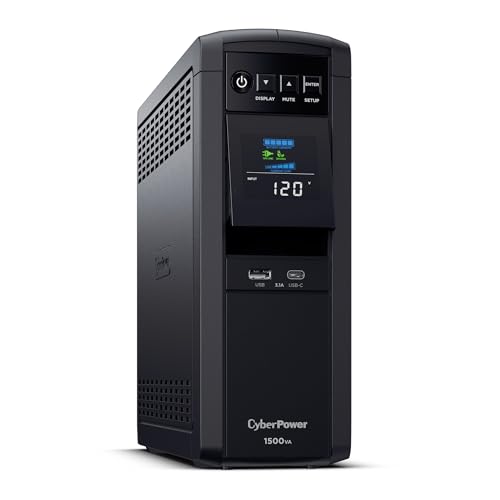
- 1500VA/1000W PFC Sinewave Uninterruptible Power Supply (UPS): Uses sine wave output to provide battery backup power f…
- 12 NEMA 5-15R OUTLETS: 6 battery backup & surge protected outlets, 6 surge protected outlets; INPUT: NEMA 5-15P right…
- MULTIFUNCTION, COLOR LCD PANEL: Displays immediate, detailed information on battery and power conditions; Color displ…
Multi-hour outages: LiFePO4 power stations
Once you need hours, UPS internals stop being the efficient answer. A LiFePO4 power station gives you far more watt-hours per unit of weight, tolerates thousands of cycles, and often includes a UPS passthrough mode so it can sit inline like a conventional UPS and only discharge when the grid drops.
The EcoFlow River 3 Plus is the compact end: 286Wh with 600W steady output, under 10 ms UPS switchover, and stackable extra batteries that take the system to 858Wh. It is small enough to live on a shelf next to the Starlink router.

- [<10 MS UPS]-The RIVER 3 Plus power station ensures <10 ms switchover for premium UPS protection, securing your home…
- [Power up to 1200W]-RIVER 3 Plus portable power station delivers a steady 600W and surges to 1200W with X-Boost. It f…
- [2× Runtime & Ultra-Quiet]-The RIVER 3 Plus battery generator, powered by X-GaNPower, boosts energy efficiency, givin…
Stepping up, the Jackery Explorer 1000 v2 offers 1,070Wh and 1,500W of pure sine wave AC output in a 23.8 lb package, with an LFP pack rated above 70 percent capacity after 4,000 cycles. The Anker SOLIX C1000 Gen 2 is close in capacity at 1,024Wh with 2,000W output across ten ports, and accepts up to 600W of solar input. Solar matters on acreage, because a multi-day outage turns into a recharging problem rather than a capacity problem.

- Powerful yet Compact: Boasting a 1,500W AC output and a 3,000W surge peak, the Solar Generator 1000 V2 can power mult…
- One Hour Fast Charging: Charge your Explorer 1000 v2 Portable Power Station from 0% to 100% battery level in just one…
- 10 Year Lifespan: The Explorer 1000 v2 portable power station is equipped with a durable LFP battery, maintaining ove…

- 49 Min UltraFast Recharging: With upgraded HyperFlash tech, fully recharge at 1,600W—for outage prepping, camping tri…
- 2,000W Output via 10 Ports: Delivers 2,000W (3,000W peak) and 1,024Wh capacity. Power up to 10 devices—ideal for emer…
- Compact and Portable: Easily carry, store, and move from room to room, your RV, or even on beach and park outings. C1…
| Model | Type | Rated output | Stated capacity | Notable for a Starlink island |
|---|---|---|---|---|
| APC BR1500MS2 | Line-interactive UPS | 1500VA / 900W | Not published; rated up to 73 min at 100W | AVR, user-replaceable battery (APCRBC163) |
| CyberPower CP1500PFCLCD | Line-interactive UPS | 1500VA / 1000W | Not published | Colour LCD load and battery readout, 12 outlets |
| EcoFlow River 3 Plus | LiFePO4 power station | 600W steady, 1200W X-Boost | 286Wh, expandable to 858Wh | Under 10 ms switchover, stackable batteries |
| Jackery Explorer 1000 v2 | LiFePO4 power station | 1500W, 3000W peak | 1,070Wh | 100W USB-C PD output, 23.8 lb carry weight |
| Anker SOLIX C1000 Gen 2 | LiFePO4 power station | 2000W, 3000W peak | 1,024Wh | Accepts 600W solar for multi-day outages |
A worked sizing example
The formula is usable watt-hours divided by total watts. Take a 1,024Wh pack and apply a 15 percent conversion allowance: about 870Wh reaches the load. A Standard kit planned at 90W gives roughly 9.5 hours.
Now add the rest of the chain. An eight-port switch and a couple of mesh nodes might add 20W together, bringing the load to 110W and the window down to roughly 7.9 hours. Run the same sum on a 286Wh unit and you get about 243Wh usable, which is a bit over two and a half hours for a Standard kit but closer to eight for a Mini drawing 30W.
Put the whole path on one battery
A powered dish connected to a dead switch is still an offline house. Whatever battery you choose, the Starlink router, any downstream switch, mesh nodes and PoE injectors belong on the same backed-up outlets. Our guide to backup internet and LTE failover covers the case for a second path alongside Starlink, and the same battery should carry that modem too.
Trade-offs and who should choose something else
A UPS buys you clean, always-inline protection and AVR, but its runtime at network loads is measured in tens of minutes. A power station buys you hours and solar recharge, at the cost of a bulkier box and, on some models, a switchover that is fast but not truly zero.
If your outages routinely run past a day, batteries are the wrong layer to solve the problem. A generator or a whole-home battery system is the better answer, with the power station kept as the quiet overnight bridge. Any transfer switch or sub-panel work must follow local electrical code and, in most jurisdictions, be done by a licensed electrician.
What to actually buy
For brownout-prone lines and short interruptions, the APC BR1500MS2 is the sensible default: pure sine wave output, automatic voltage regulation, a user-replaceable battery, and a published runtime figure that lines up with a Starlink-plus-router load. The CyberPower CP1500PFCLCD suits anyone who wants the load and battery status visible at a glance.
For rural properties with multi-hour outages, start at the Anker SOLIX C1000 Gen 2 or Jackery Explorer 1000 v2 and plan for a solar input if restoration times on your feeder run long. Keep the EcoFlow River 3 Plus in mind as a Mini-sized companion or as the unit you carry to the shop. Readers facing storm season specifically should also read our storm season UPS sizing guide before settling on a final capacity.
How these picks were chosen: HomeNode compares products using manufacturer specifications, current Amazon listing details and published owner feedback. Products are not tested in-house, and listings change often, so confirm current specifications on the product page before buying.
Affiliate disclosure: As an Amazon Associate, HomeNode earns from qualifying purchases at no additional cost to you.