
You land in a hotel room, connect the laptop to the guest Wi-Fi, and suddenly nothing on your home network is reachable. Proxmox, the NAS share, Home Assistant, the internal DNS names you use every day — all gone, sitting behind a firewall a thousand miles away. A pocket travel router fixes that by becoming the one device that authenticates to the hotel network, then handing everything behind it a private, encrypted path home.
This guide is for home lab owners who already run some form of remote access and want it to work automatically for every device they carry, not just the one browser they remembered to configure. The interesting part is not the Wi-Fi radio. It is the fact that these boxes run OpenWrt with a WireGuard client baked in, so a tunnel can come up before your laptop even finishes booting.
We compared the current GL.iNet lineup on the attributes that actually matter when the tunnel is doing the heavy lifting: encryption throughput headroom, Wi-Fi generation, port count, USB power flexibility and how each model handles captive portals. Here is how to size one properly.
What a travel router actually solves
Three problems, really. First, device sprawl: a phone, a tablet, a work laptop and a streaming stick each need to be registered against the hotel’s portal, and most hotel systems cap you at two or three MAC addresses. Put a travel router in front and the portal only ever sees one client.
Second, trust. Hotel and cafe networks put you on a flat broadcast domain with strangers. Behind a travel router your devices sit on their own subnet, with NAT and a firewall between them and everyone else in the building, which matters more than people assume for a laptop with SMB shares mounted.
Third, reachability. Once the router holds a WireGuard tunnel to your home lab, every device behind it inherits that route. No per-device VPN client, no split-tunnel surprises on a locked-down work machine, no fiddling with a phone that keeps dropping its profile.

- 【DUAL BAND AX TRAVEL ROUTER】Products with US, UK, EU Plug; Dual band network with wireless speed 574Mbps (2.4G)+2402M…
- 【VPN CLIENT & SERVER】OpenVPN and WireGuard are pre-installed, compatible with 30+ VPN service providers (active subsc…
- 【OpenWrt 21.02 FIRMWARE】The Beryl AX is a portable wifi box and mini router that runs on OpenWrt 21.02 firmware. It s…
WireGuard or Tailscale: which client to run on the road
WireGuard is the lower-level option and the faster one. You run a WireGuard server at home — on your firewall, a Raspberry Pi, or the router itself — and load the peer config onto the travel router. GL.iNet ships WireGuard and OpenVPN pre-installed on the Beryl AX, Slate 7, Slate AX and Opal, and the admin panel will import a config file without you touching the command line.
Tailscale sits on top of WireGuard and handles the hard part: NAT traversal. If your home connection is behind CGNAT, or you simply do not want to open a UDP port, Tailscale’s coordination service negotiates the connection for you. Installed as an OpenWrt package and configured as a subnet router, it exposes your whole home LAN to the travel router without any port forwarding at all. Our guide to accessing Home Assistant remotely without port forwarding walks through the same pattern from the home side.
Policy routing is the feature to look for
GL.iNet’s firmware lets you decide which clients, domains or destinations go through the tunnel and which go direct. That matters because forcing a work video call through a residential upload link is usually worse than sending it straight out. Route your lab subnets home, let everything else take the local path.

- 【DUAL BAND WIFI 7 TRAVEL ROUTER】Products with US, UK, EU, AU Plug; Dual band network with wireless speed 688Mbps (2.4…
- 【NETWORK CONTROL WITH TOUCHSCREEN SIMPLICITY】Slate 7’s touchscreen interface lets you scan QR codes for quick Wi-Fi…
- 【OpenWrt 23.05 FIRMWARE】The Slate 7 (GL-BE3600) is a high-performance Wi-Fi 7 travel router, built with OpenWrt 23.05…
Repeater, tethering or wired: how the router gets online
Repeater mode is the common case. The router joins the hotel SSID as a client and rebroadcasts its own private SSID, so your devices never change networks between rooms, airports or a friend’s house — you just re-point the uplink.
Tethering is the fallback when venue Wi-Fi is unusable. Plug a phone into the USB port and the router shares the cellular connection to everything behind it. That is the same failover logic covered in our piece on 5G cellular backup routers for home outages, just shrunk into a pocket.
Wired uplink is the best option when a room has a live Ethernet jack, and it is where the 2.5G WAN ports on the Beryl AX and Slate 7 earn their keep at conference venues and short-term rentals with fast fibre.
Captive portals without the headaches
The Slate AX listing explicitly notes captive portal support, and the firmware across the range handles the usual pattern: connect, get redirected, accept terms in a browser. Two practical tricks help. Clone a device MAC address the portal has already approved, and keep a scheduled reconnect for networks that time out after a fixed period.
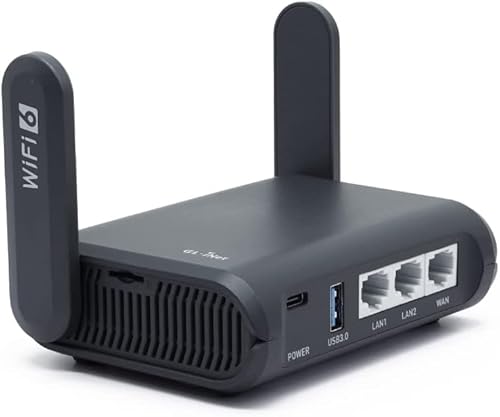
- 【AXT1800 WiFi 6 Wireless Router】Slate AX offers powerful Wi-Fi 6 network connection with a dual-band combined Wi-Fi s…
- 【Fast and Secure Browsing】IPv6 supported; OpenVPN & WireGuard pre-installed, compatible with 30+ VPN service provider…
- 【Easy File Sharing】Our NAS feature supports SAMBA and WebDav protocol. By plugging an external USB hard disc into the…
Comparing the models on paper
| Model | Wi-Fi generation | Rated wireless speeds | Ethernet | USB / firmware |
|---|---|---|---|---|
| GL-BE3600 Slate 7 | Wi-Fi 7, dual band | 688 Mbps (2.4G) + 2882 Mbps (5G) | Dual 2.5G (1 WAN, 1 LAN) | USB 3.0, OpenWrt 23.05, 512MB storage |
| GL-MT3000 Beryl AX | Wi-Fi 6, dual band | 574 Mbps (2.4G) + 2402 Mbps (5G) | 2.5G WAN + 1G LAN | USB 3.0, OpenWrt 21.02 |
| GL-AXT1800 Slate AX | Wi-Fi 6, dual band | 600 Mbps (2.4G) + 1200 Mbps (5G) | Gigabit | USB, OpenWrt 21.02, SAMBA/WebDAV NAS |
| GL-SFT1200 Opal | Wi-Fi 5 (AC1200) | 300 Mbps (2.4G) + 867 Mbps (5G) | 1 Gigabit WAN + 2 Gigabit LAN | OpenVPN & WireGuard pre-installed |
| GL-MT300N-V2 Mango | 2.4GHz only | Not listed | 2 Ethernet ports | USB 2.0, OpenWrt, 128MB RAM / 16MB flash |
Sizing by throughput, power and radio
Encryption is the bottleneck on every device in this class. The Wi-Fi numbers above describe the radio, not what the CPU can push through a tunnel — GL.iNet quotes the Slate AX at up to 550 Mbps on WireGuard, with OpenVPN well below that, and WireGuard is consistently the lighter of the two protocols because it runs in kernel space with a much smaller cipher set.
Work backwards from what you need. Reaching a Home Assistant dashboard, SSHing into a hypervisor or syncing files needs very little. Pulling 4K from a home Plex server over the tunnel, or copying large datasets back to the NAS, is where the faster silicon in the Beryl AX and Slate 7 pays off.
Power matters more than specs suggest
USB-C power means one charger for the laptop, the phone and the router. The Mango is the extreme case here: 39g, and it runs off a laptop USB port, a power bank or a 5V/2A adapter. The Wi-Fi 6 and Wi-Fi 7 models draw more, so pair them with a high-output port rather than a spare hub and expect instability if you undersupply them.
On the radio itself, Wi-Fi 7 on the Slate 7 helps mainly on the LAN side, where your own devices talk to the router. Hotel uplinks rarely saturate even Wi-Fi 5. The touchscreen is the bigger day-to-day difference: QR code Wi-Fi joins and a VPN toggle you can hit without opening a browser.
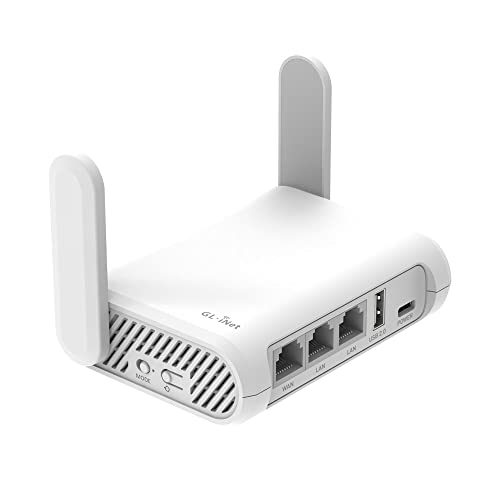
- 【AC1200 Dual-band Wireless Router】Simultaneous dual-band with wireless speed up to 300 Mbps (2.4GHz) + 867 Mbps (5GHz…
- 【Easy Setup】Please refer to the User Manual and the Unboxing & Setup video guide on Amazon for detailed setup instruc…
- 【Pocket-friendly】Lightweight design(145g) which designed for your next trip or adventure. Alongside its portable, com…
Trade-offs and who should choose something else
If your travel is occasional and your needs are a private SSID plus a tunnel for browsing, the Opal or the Mango cover it with less to carry and less to configure. The Mango in particular is a 2.4GHz single-band device with 16MB of flash, so it prioritises pocketability and hardware hackability over tunnel throughput or package headroom.
If the real problem is remote access from a fixed second location — a holiday home, a parent’s house — a travel router is the wrong shape. A small firewall appliance running a permanent site-to-site tunnel is more appropriate, and our comparison of pfSense alternatives for home firewalls is a better starting point.
Streaming devices deserve a warning. Routing a Fire Stick or Apple TV through your home connection does restore region-locked catalogues and lets local casting work, but playback quality is limited by your home upload speed and by whatever the venue’s link allows. Some services actively detect tunnelled traffic. Treat it as a bonus rather than the reason to buy.
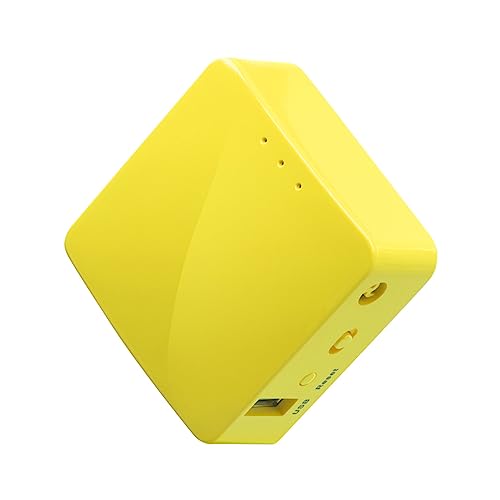
- 【WIRELESS MOBILE MINI TRAVEL ROUTER】 Convert a public network (wired or wireless) to a private Wi-Fi for secure surfi…
- 【OPEN SOURCE & PROGRAMMABLE】 OpenWrt pre-installed, USB disk extendable.
- 【LARGER STORAGE & EXTENDABILITY】 128MB RAM, 16MB Flash ROM, dual Ethernet ports, UART and GPIOs available for hardwar…
The practical recommendation
For most home lab owners, the GL-MT3000 Beryl AX is the sensible default. Wi-Fi 6, a 2.5G WAN port for wired uplinks, USB 3.0 for tethering or storage, and enough CPU that a WireGuard tunnel to your lab is not the thing you notice. It is the smallest device that does not feel like a compromise.
Choose the GL-BE3600 Slate 7 if you want the newest firmware base, dual 2.5G ports and the touchscreen, which genuinely changes how often you open the admin panel. The GL-AXT1800 Slate AX remains a strong pick when USB NAS sharing over SAMBA or WebDAV is part of your travel kit and published VPN throughput figures matter to you.
Whichever you pick, configure it at home first. Bring the tunnel up on your own network, confirm your lab subnets resolve, and save the config — then it is a five-minute job in a hotel room instead of an evening of troubleshooting. The same discipline applies to the rest of your kit, as covered in our home office networking setup guide.
How these picks were chosen: HomeNode compares products using manufacturer specifications, current Amazon listing details and published owner feedback. Products are not tested in-house, and listings change often, so confirm current specifications on the product page before buying.
Affiliate disclosure: As an Amazon Associate, HomeNode earns from qualifying purchases at no additional cost to you.