
AI-narrated version of this post using a synthetic voice. Great for accessibility or listening while busy.
Beelink has built its reputation on packing a lot of hardware into a very small box and giving you more ports than the size suggests. The range stretches from Intel N-series boxes that sip power to Core Ultra machines with a PCIe slot and dual 10GbE. That breadth is the appeal, and also the problem: five models can look nearly identical in a listing photo while behaving completely differently in a 24/7 rack.
This guide is for anyone deciding which Beelink to put under the TV, in a cupboard as a Proxmox node, or on a shelf as an all-flash NAS. The focus is on the specifications that change how the machine behaves over years of uptime: soldered memory versus SO-DIMM, how many M.2 slots you get, which network controller is fitted, and whether the iGPU can hardware-transcode your media library.
Every product fact below comes from the current listings. Beelink revises components between production runs, so anything that matters to your build deserves a check against the maker’s spec sheet before you order.
The Beelink lineup at a glance
The range splits into three tiers. Intel N150 models target low idle draw and storage density. AMD Ryzen SER models trade some efficiency for eight cores and the Radeon 780M. The GTi14 sits on its own: a desktop-class Core Ultra chip aimed at people who would otherwise build a small tower.
| Model | CPU | Memory as listed | Wired networking | Internal storage slots |
|---|---|---|---|---|
| EQ14 | Intel N150, 4C/4T | 16GB SO-DIMM DDR4 | Dual 2.5GbE | 2x M.2 PCIe 3.0 |
| ME Mini | Intel N150, 4C/4T | 12GB LPDDR5 (soldered) | Dual 2.5GbE, Intel i226-V | 6x M.2 plus 64GB eMMC |
| SER8 | Ryzen 7 8745HS, 8C/16T | 32GB DDR5, dual SO-DIMM | Single 2.5GbE | M.2 2280 PCIe 4.0 |
| SER9 Pro | Ryzen 7 H 255, 8C/16T | 24GB LPDDR5X (soldered) | Single 2.5GbE | 2x M.2, up to 8TB |
| GTi14 Pro | Core Ultra 9 185H, 16C/22T | 32GB DDR5, dual SO-DIMM | Dual 10GbE | 2x M.2 PCIe 4.0, PCIe x8 slot |
The N150 efficiency pair
EQ14: a quiet always-on box with dual 2.5GbE
The EQ14 runs the Twin Lake N150 at up to 3.6GHz across four cores, with 16GB of DDR4 in a SO-DIMM slot and a 500GB M.2 2280 drive in one of its two PCIe 3.0 slots. Two 2.5Gbps LAN ports make it a plausible OPNsense or pfSense host, and the second M.2 slot means you can separate boot and data. Beelink lists Ubuntu support alongside Windows 11.
Skip it if you want to run a stack of virtual machines; four cores with no hyper-threading fills up fast.
- Powerful Performance: Beelink EQ14 mini pc is powered by Intel Processor Twin Lake-N150 (More Faster Than 12th Genera…
- High-capacity Storage: The micro desktops computer built-in 16GB SO-DIMM DDR4, 500GB M.2 2280 PCIe3.0 x4 NVMe/SATA3 S…
- Multiple Interfaces & Function: The desktop computer adopts independently designed heat dissipation technology, it ru…
ME Mini: six M.2 slots and an all-flash NAS brief
Six M.2 slots is the headline, with Beelink quoting up to 24TB total and support for 2230, 2242 and 2280 drives. A 64GB eMMC module holds the operating system, which keeps all six slots free for your array — a genuinely useful design choice for TrueNAS or UnRAID. The dual 2.5GbE ports use Intel i226-V controllers, and Intel NICs tend to be the path of least resistance under BSD and Linux hypervisors.
The 12GB of LPDDR5 is soldered. For ZFS that is the real ceiling, since you cannot add RAM later for cache or extra services. Choose carefully among drives too; the picks in our guide to M.2 NVMe SSDs for a home lab cover endurance ratings that matter more in an always-on array than peak sequential speed.

- 【Powerful Intel N150 Processor & 12GB LPDDR5 RAM】The Beelink mini PC is equipped with an Intel N150 processor (4 core…
- 【High-Speed Network Connectivity】Equipped with dual 2.5G Ethernet ports (Intel i226-v) for link aggregation (5Gbps co…
- 【64GB eMMC + 2TB SSD & Expandable to 24TB】Features 64GB eMMC for system installation and a 2TB PCIe SSD (Slot 4) for…
The Ryzen SER pair
SER8: eight cores with memory you can replace
The SER8 pairs a Ryzen 7 8745HS, eight cores and sixteen threads up to 4.9GHz, with 32GB of DDR5 in two SO-DIMM slots. That upgradeability is its strongest argument for a home lab. The Radeon 780M drives up to three displays at 4K 120Hz, so it doubles as a capable desktop.
Networking is where you compromise: a single 2.5Gbps port, so a second interface for a Proxmox bridge means an adapter. AMD’s video engine handles mainstream codecs, but Plex and Jellyfin users with awkward libraries often find Intel Quick Sync the smoother route.

- 🔥【POWERFUL PERFORMANCE】Beelink SER8 ryzen mini pc equips with 8-core/16-thread AMD Ryzen 7 8745HS(up to 4.9GHz), The…
- 🔥【CAPACITY STORAGE】This Mini Computer comes with the AMD 4nm Processor, 32G DDR5 Memory(can upgrade to 256GB, 2 x 12…
- 🔥【4K@120HZ HD & TRIPLE DISPLAY】Beelink Mini PC integrates AMD Radeon 780M 12core 2600 MHz GPU to deliver powerful gr…
SER9 Pro: faster silicon, fixed memory
The SER9 Pro uses the Ryzen 7 H 255, also eight cores and sixteen threads to 4.9GHz with 16MB of cache, and 24GB of LPDDR5X soldered to the board. LPDDR5X draws less power and runs faster than SO-DIMM DDR5; the cost is that 24GB is permanent. Two M.2 slots take up to 8TB between them, and USB4 joins HDMI and DP 1.4 for triple-display work.
Decide on the memory question first. For a desktop or a light container host, 24GB is plenty. For nested virtualisation or a big ZFS cache, the SER8 or GTi14 are the better long-term bet — a theme we return to in our roundup of mini PCs for a Proxmox home lab.

- 【AMD Ryzen 7 H 255 Processor】The Beelink SER9 PRO mini pc is powered by AMD Ryzen 7 H 255(8C/16T,up to 4.9 GHz,16M Ca…
- 【High Capacity & Expansion Options】Our Ryzen7 H 255 mini PC is built-in 24GB LPDDR5X RAM.LPDDR5X offers higher perfor…
- 【4K Triple Screen Display & 2.4 Gbps Wifi6 & BT5.2】Beelink SER9 PRO micro PC comes with Radeon 780M graphics(12 cores…
GTi14 Pro: dual 10GbE and a PCIe slot
This is the model for people who want one box to do everything. The Core Ultra 9 185H brings 16 cores and 22 threads up to 5.1GHz, Intel Arc graphics with Quick Sync for transcoding, 32GB of DDR5 across two SO-DIMM slots that Beelink says accept 48GB modules, and two M.2 PCIe 4.0 slots. The port list includes two 10G LAN ports, five 10Gbps USB-A, a 40Gbps USB-C, an SD card reader and a PCIe x8 slot.
Dual 10GbE on a mini PC is unusual and changes what the machine can be: a virtualisation host with a dedicated storage network, or a router handling multi-gig WAN. It also draws more at idle than an N150 box, so run it where a few extra watts around the clock are acceptable.
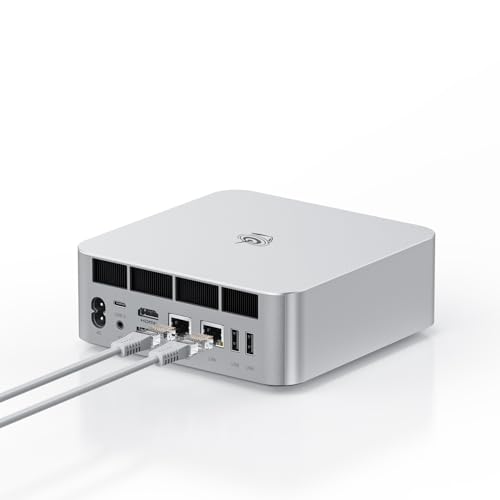
- ➊【The newest Intel AI CPU -Intel Core Ultra 9 185H】Model Number: GTI; Brand: Beelink; Manufacturer: Shenzhen AZW Tech…
- ➋【Intel Arc Graphics 2.35GHz & 4K UHD】The Beelink GTi14 mini desktop PC features Intel Arc Graphics integrated graphi…
- ➌【32G DDR5 RAM+1TB Pcle4.0SSD】The Beelink mini PC comes with 32GB DDR5 RAM (Dual SO-DIMM RAM Solts up to 48GB*2) and…
Software, firmware and honest trade-offs
Beelink ships Windows pre-installed and offers lifetime technical support on these listings, with a three-year warranty quoted on the GTi14 Pro. What you do not get is the kind of long-term BIOS and driver portal that enterprise vendors maintain. Firmware updates exist but are distributed less formally.
The other recurring issue is component substitution. Wi-Fi modules, SSD brands and occasionally network controllers change between batches, which is why confirming the exact NIC is worth five minutes before you commit to OPNsense. Anyone wanting a vendor-maintained NAS operating system and a tested drive compatibility list should look at a purpose-built appliance instead, and people who care mainly about efficiency per watt for Plex should read our comparison of the Mac mini M4 against x86 mini PCs.
Which one to choose
For an all-flash NAS or a quiet TrueNAS box, the ME Mini is the obvious pick — six M.2 slots and Intel i226-V NICs are hard to find anywhere else this small, provided 12GB of RAM suits your workload. For a low-power router, DNS host or Home Assistant machine, the EQ14 with its two 2.5GbE ports and replaceable DDR4 is the sensible, unglamorous choice.
Pick the SER8 if you want a Proxmox node with room to grow memory, or the SER9 Pro if you want the faster chip and USB4 in a desktop role and can live with 24GB forever. The GTi14 Pro earns its place when dual 10GbE, 22 threads or the PCIe slot solve a problem the others cannot — a single-box virtualisation host, for instance, built out with the drives covered in our NVMe SSD picks for home servers.
How these picks were chosen: HomeNode compares products using manufacturer specifications, current Amazon listing details and published owner feedback. Products are not tested in-house, and listings change often, so confirm current specifications on the product page before buying.
Affiliate disclosure: As an Amazon Associate, HomeNode earns from qualifying purchases at no additional cost to you.