
AI-narrated version of this post using a synthetic voice. Great for accessibility or listening while busy.
Affiliate disclosure: As an Amazon Associate, HomeNode earns from qualifying purchases at no additional cost to you.
Short answer: If your modem, ONT and router all run on 12V or 9V barrel plugs, a DC mini UPS is the simpler and more efficient choice, and the TalentCell Mini UPS 27000mAh is the one to look at for long runtime on a single router-and-ONT pair. Pick the CHINTE Mini UPS Battery Backup instead if you need PoE output for a camera or access point, or a mix of 5V, 9V and 12V rails from one box. If any device on the shelf has a fixed AC brick, or you also want a NAS or desktop covered, go with an AC unit like the APC BE600M1 or the Eaton Tripp Lite BC350RNC.
This guide is for people whose internet drops for five or fifteen minutes at a time because of grid flicker, utility switching or a storm passing through, while the fibre or cable plant outside stays alive. In those cases the only thing standing between you and a working connection is the small pile of power adapters behind the TV or in the wiring closet.
It is also for anyone who has looked at a tower UPS, measured the cupboard it would have to live in, and decided there has to be something smaller. There is, and it works well, as long as you check the voltages first.
Why DC backup makes sense on a router shelf
A conventional UPS stores energy in a battery at roughly 12V, inverts it up to 120V AC, and then your router’s wall wart converts it straight back down to 12V DC. Each conversion wastes energy as heat. A DC mini UPS skips both steps and hands the battery voltage almost directly to the device.
That efficiency gain matters most at the tiny loads a router shelf actually draws. Small AC units also spend a share of their capacity just keeping the inverter running, which eats into runtime when the connected load is only a handful of watts. These packs are shelf-sized rather than floor-sized, too.

- High capacity: 3.7V/ 27000mAh (11.1V/ 8800mAh). This lithium ion battery is constructed from lithium ion battery cell…
- Mini uninterruptible power supply back up battery pack can power for most 12V/9V/5V DC equipment, wireless routers, t…
- Provide short-circuit, over-current and over-charging/discharging protection. This product cannot continuously power…
Matching voltage, connector and current
This is where most purchases go wrong. Read the label on each power brick you want to back up and write down three things: output voltage, output current, and the barrel size if it is printed.
Barrel plugs and voltage rails
The TalentCell unit uses DC 5.5 x 2.1 mm ports for input and output, offers four 12V outputs plus one 9V and two USB 5V, and its 12V rail is specified as a 9–12.6V range because it tracks cell voltage as the pack discharges. Most 12V network gear tolerates that range, but a device that insists on a regulated 12.0V may not. TalentCell also states the pack cannot continuously power loads above 37W.
The CHINTE unit splits its outputs into DC 12V at 1A, 9V at 1A and 5V at 2A, with USB-A and USB-C at 5V/2A, and up to 18W total. Note the per-rail current limits: a 12V router rated at 1.5A sits outside that 1A figure even though the pack’s total wattage looks sufficient. A different barrel diameter means buying an adapter tip separately.
PoE devices and mesh nodes
The CHINTE model adds PoE output at 15V/0.6A and 24V/0.4A, which covers passive-PoE cameras, some IP phones and older access points. It does not describe 802.3af/at negotiation, so treat it as passive PoE and confirm your device accepts that first.
Mesh systems are the awkward case. Backing up the primary node keeps routing and DHCP alive, but satellite nodes each need their own power, so coverage shrinks to the area around the main node unless you budget a small pack per node. Our notes on mesh Wi-Fi for cottages and cabins are worth a read if your layout depends on satellites. If you are running cable through walls to feed remote nodes, follow local electrical code and use a licensed electrician where it is required.

- Wide Device Compatibility: This mini UPS features multiple output options, including DC 12V-1A / 9V-1A / 5V-2A, USB-A…
- Multiple Safety Protections: Built with an intelligent control system, this mini DC UPS helps regulate abnormal input…
- Reliable Backup Power for Routers During Outages: Built with a 10,400mAh LiFePO4 battery and up to 18W output, this m…
Estimating runtime before you buy
Capacity in milliamp-hours means nothing on its own, because it is quoted at cell voltage rather than output voltage. Convert to watt-hours instead: multiply mAh by the pack’s nominal voltage and divide by 1000. TalentCell publishes this directly at 97.2Wh for its 27000mAh rating, the same pack expressed as 11.1V/8800mAh.
Then divide watt-hours by the combined wattage of your devices and shave off a margin for conversion loss. A fibre ONT and a consumer router together typically sit in the single-digit to low-teens watt range, so a pack of that size covers a short outage with headroom. Push the same pack with a power-hungry Wi-Fi 7 router plus a PoE camera and the arithmetic turns against you quickly. Manufacturer capacity figures are measured under ideal conditions, so plan for less than the paper number.
Comparing the four approaches
| Model | Energy storage | Output type | Notable detail |
|---|---|---|---|
| TalentCell Mini UPS 27000mAh | 97.2Wh lithium ion, 11.1V/8800mAh | 4x DC 12V (9–12.6V), 1x DC 9V, 2x USB 5V, 18W USB-A/USB-C PD | 5.5 x 2.1 mm ports; not for continuous loads above 37W |
| CHINTE Mini UPS Battery Backup | 10400mAh LiFePO4 | DC 12V/1A, 9V/1A, 5V/2A, USB-A and USB-C 5V/2A, PoE 15V/0.6A and 24V/0.4A | Up to 18W output; LED capacity indicator; 12-month warranty |
| APC BE600M1 | 600VA / 330W, replaceable APCRBC154 | AC: 5 battery-backed outlets, 2 surge-only, 1.5A USB | Rated 23 minutes at 100W; 490 J surge protection |
| Eaton Tripp Lite BC350RNC | 350VA / 210W, replaceable AG-075F | AC: 3 battery-backed outlets | Cloud monitoring and alerts; 100 x 100 mm VESA mounting; 190 J surge |
Chemistry and lifespan
The CHINTE pack uses LiFePO4, the more heat-tolerant chemistry and generally rated for far more charge cycles than standard lithium ion. That matters because a mini UPS sits on float charge permanently, often in a warm cupboard. The TalentCell pack trades that for more stored energy in a similar footprint. Both AC models name their replacement battery part, so the chassis outlives the cells.
When a regular AC UPS is the better answer
Three situations tip the decision back to AC. First, any device with a non-standard or proprietary power input: some cable modems and gateways use connectors that no DC pack will match. Second, mixed loads, where a NAS, a switch and a mini PC need to stay up alongside the router. Third, surge protection, which DC mini UPS units generally do not provide at mains level.
Long outages also favour AC gear, or something larger still. If your power goes out for hours rather than minutes, look at whole-home battery backup and power stations rather than stacking DC packs. For a home lab with servers behind it, our guide to UPS battery backup for home servers covers sizing properly, and there is a separate round-up of entry-level CyberPower, APC and Tripp Lite models.
A backed-up router cannot fix an outage that also took down the neighbourhood fibre cabinet. Pairing battery backup with a 5G cellular backup router covers the other half of the problem.
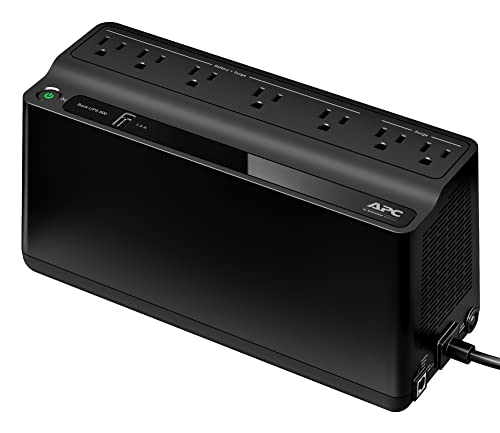
- KEEP YOUR COMPUTER, WI-FI AND ROUTER RUNNING THROUGH POWER OUTAGES: Supplies short-term battery power during outages…
- POWER PROBLEMS DON'T ONLY HAPPEN DURING STORMS: 23 minutes of runtime (at 100W load) guards against outages, while su…
- PROTECT EVERYTHING ON YOUR DESK: 5 well-spaced outlets with full battery backup and surge protection, plus 2 surge-on…
What to buy
For a straightforward fibre setup where the ONT and router both take 12V barrel plugs, the TalentCell Mini UPS 27000mAh gives the most stored energy of the DC options and has enough outputs to feed both plus a phone. Check your barrel size against 5.5 x 2.1 mm first.
Choose the CHINTE Mini UPS Battery Backup when the shelf is more varied: a 9V modem, a 5V device, or a passive-PoE camera. LiFePO4 chemistry suits a unit that will be plugged in for years, and the per-rail 1A limits are the main thing to verify.
Where a DC pack cannot connect, the APC BE600M1 handles a router shelf plus a desktop and adds surge outlets, while the Eaton Tripp Lite BC350RNC is the pick for a wall-mounted closet install with remote alerting.

- 350VA SMALL UPS: 210W uninterruptible power supply provides 3-outlets of low-maintenance battery backup and surge pro…
- CLOUD-ENABLED ONLINE UPS: Monitor your UPS from anywhere via Eaton’s free Cloud portal. Configurable UPS alerts notif…
- SIMPLE SETUP WITH MASS UPS CONFIGURATION: Scanning the QR code on the UPS adds the device to Eaton's Brightlayer app…
Frequently asked questions
Will a mini UPS work with any router power adapter?
Only if the voltage, current and barrel connector all match. Check the label on the adapter against the rails listed for the pack, for example DC 12V/1A on the CHINTE unit or the 9–12.6V range on the TalentCell.
How long will a DC mini UPS keep a home connection running?
Divide the pack’s watt-hour rating, such as the TalentCell’s 97.2Wh, by the total wattage of the connected devices, then allow a margin for conversion losses. A typical ONT and router pair draws little enough that short outages are comfortably covered.
Is LiFePO4 better than lithium ion for a mini UPS?
LiFePO4, used in the CHINTE pack, tolerates heat better and generally lasts more charge cycles, which suits a device left on float charge permanently. Lithium ion, as in the TalentCell, stores more energy in a comparable size.
Can a mini UPS power a PoE access point or camera?
The CHINTE Mini UPS offers PoE output at 15V/0.6A and 24V/0.4A, which suits passive-PoE devices within those limits. Confirm the access point or camera accepts passive PoE at that voltage rather than requiring 802.3af/at negotiation.
How these picks were chosen: HomeNode compares products using manufacturer specifications, current Amazon listing details and published owner feedback. Products are not tested in-house, and listings change often, so confirm current specifications on the product page before buying.
Affiliate disclosure: As an Amazon Associate, HomeNode earns from qualifying purchases at no additional cost to you.